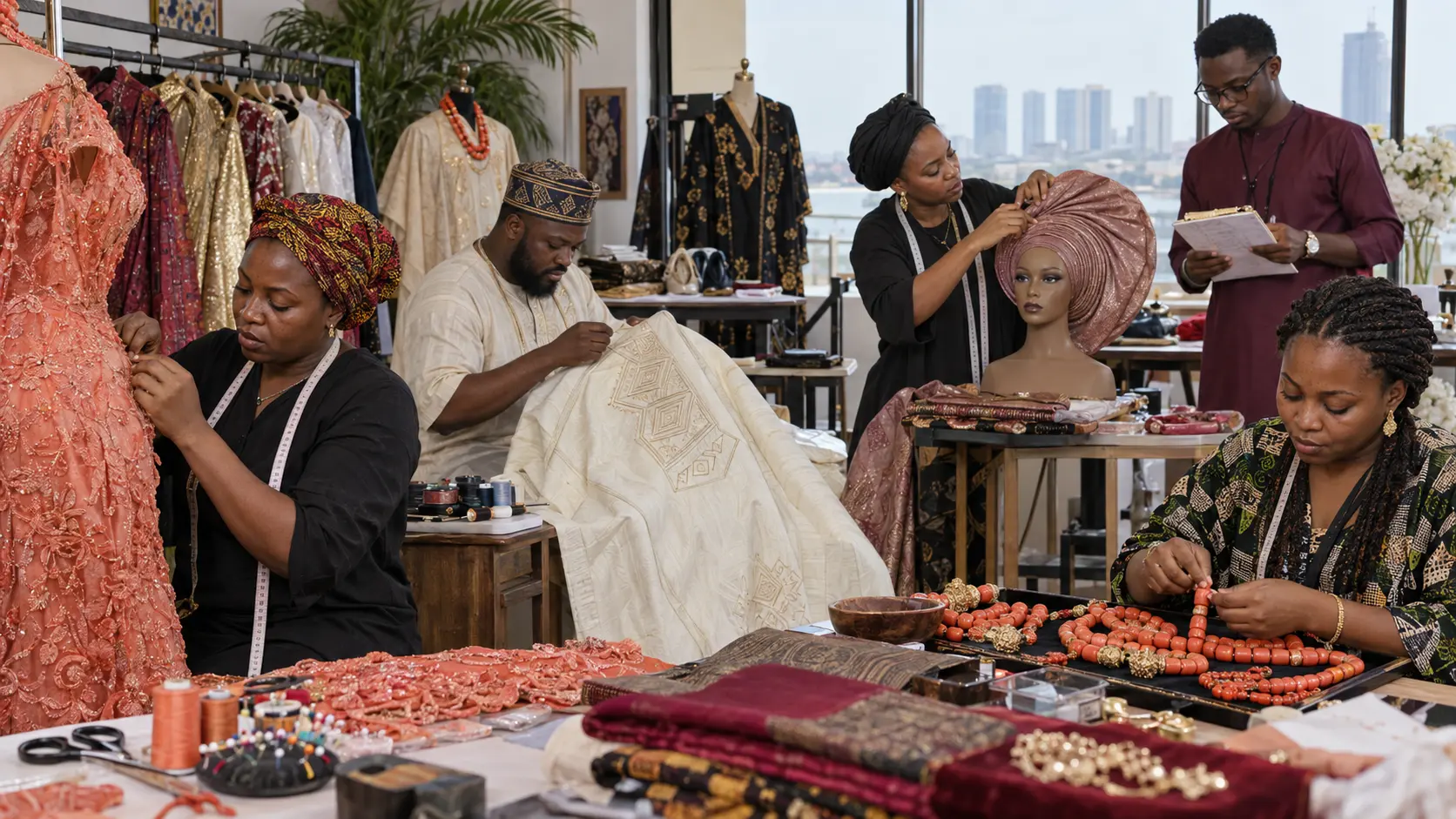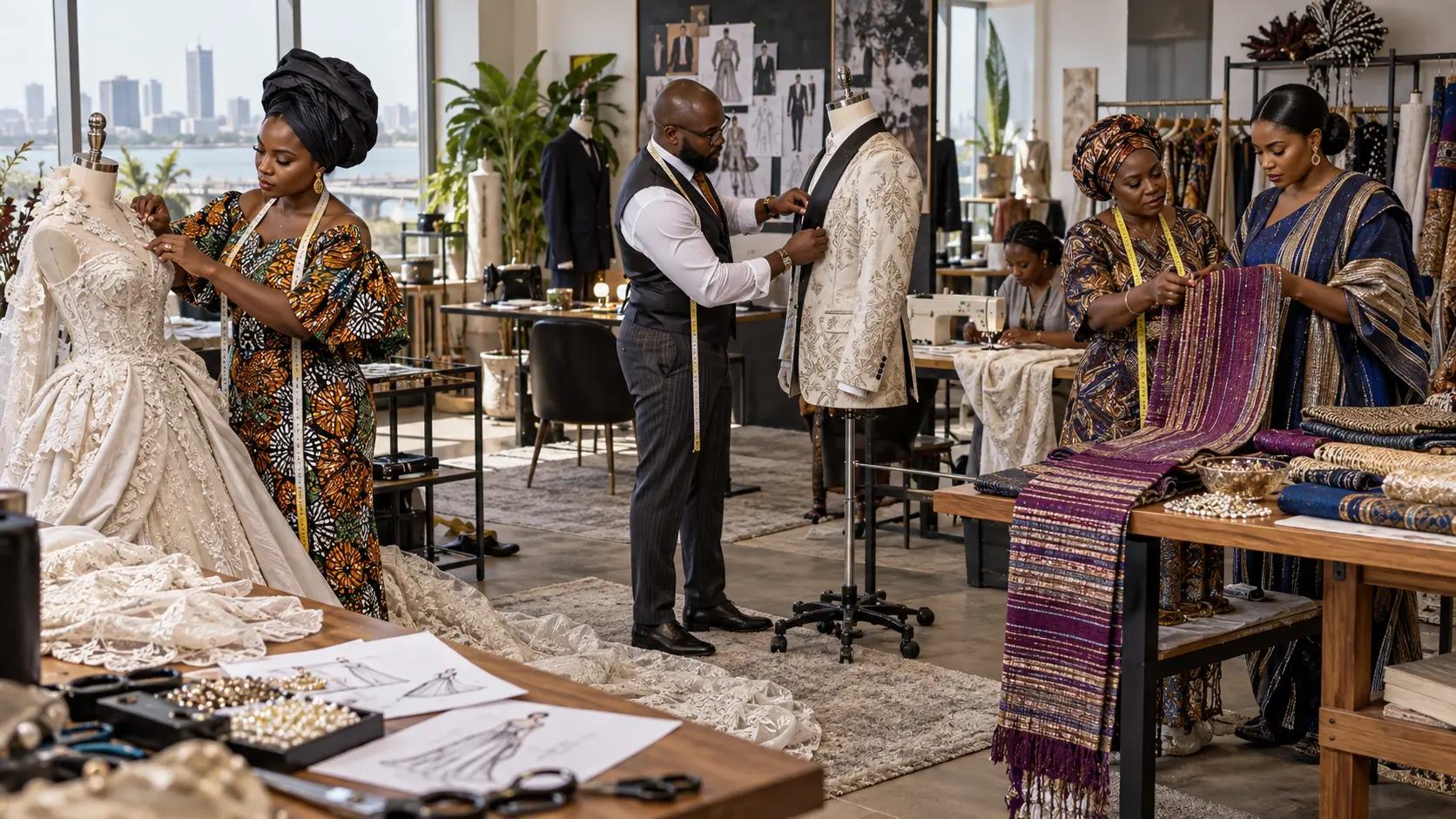
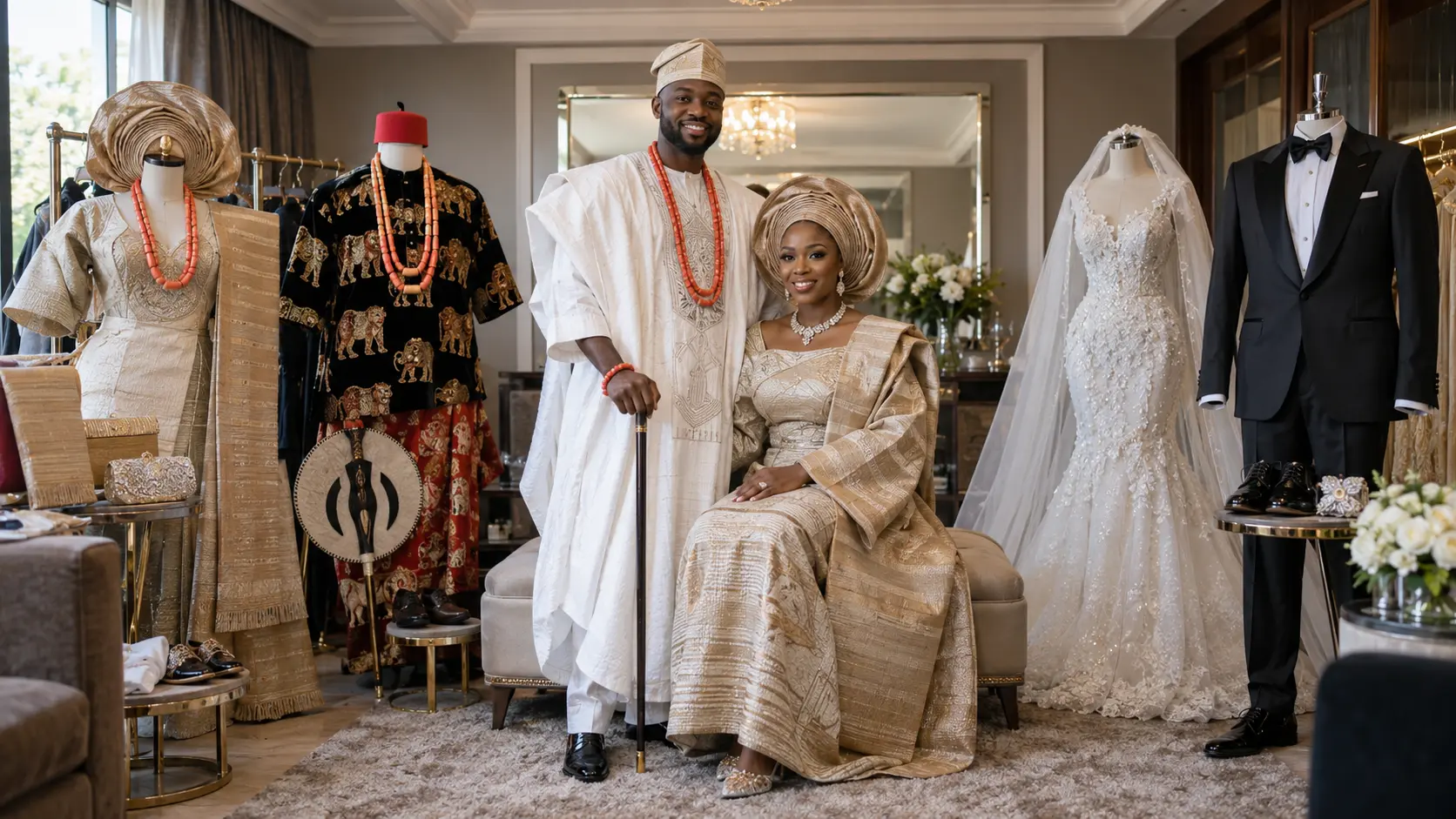
At many Nigerian weddings, the clothing changes because the social meaning changes. The couple may move from a registry ceremony to a customary engagement, a church service or nikah, and then a reception. Each stage addresses a different authority—state, family, faith or assembled community—and the wardrobe helps guests understand where they are in the story.
Among Yoruba families, handwoven aso oke may appear as the bride’s iro and buba with ipele and gele, while the groom wears agbada and fila. The cloth’s colour can coordinate the couple with parents or a wider aso ebi group. The exact form varies by family, generation and designer; there is no responsible reason to present one Lagos wedding photograph as a rule for every Yoruba community.
Cloth makes relationships visible
In many Igbo traditional marriages, wrappers, blouses, head ties and coral-coloured beads may frame the bride’s appearance, while the groom can wear isi agu, a kaftan or other locally chosen formal attire. The bride’s search for and presentation of a drink to her chosen husband is often one of the ceremony’s most photographed moments, but its significance comes from family recognition rather than from the costume around it.
Edo royal and ceremonial aesthetics have helped make layered coral beads internationally recognisable, particularly around Benin City and the authority of the Oba’s court. Their wider use in weddings shows how living symbols travel, but not every red bead set is historically equivalent to palace regalia. Naming the maker, material and community protects meaning from being replaced by a generic ‘African queen’ label.
Northern Nigerian weddings can bring together Islamic requirements, Hausa dress traditions and, depending on family identity, Fulani or other regional influences. Brides may wear richly embroidered gowns, wrappers or veils, while grooms choose baban riga, kaftans and embroidered caps. Hausa and Fulani are not interchangeable categories, even where language, religion, trade and intermarriage have produced shared influences.
Tradition changes without disappearing
The white wedding gown entered through Christian and colonial histories, yet Nigerian makers have thoroughly localised it. Designers work with lace, corsetry, hand embellishment, sculptural sleeves and detachable trains suited to a reception change. Grooms likewise move between tuxedos, suits, agbada and kaftans, allowing contemporary tailoring and inherited dress to occupy the same day without cancelling each other.
Aso ebi makes the guest list visible. The same cloth can become a fitted gown, flowing boubou, skirt set, agbada or children’s outfit, displaying individual imagination inside collective agreement. At its best, the practice says that a family is surrounded. At its worst, compulsory prices and rigid colour demands turn belonging into a financial test.
Civilisation has not overcome these wardrobes; cities, migration and digital media have changed their production and circulation. Diaspora clients send measurements by video, artisans sell through social platforms and synthetic fabrics reproduce looks once dependent on expensive handwork. The danger is not modernity itself but losing provenance, technique and fair pay while retaining only the surface.
Accuracy is more elegant than costume
A thoughtful wedding wardrobe begins with questions: Which family or ceremony does this garment honour? Who made the cloth, embroidery or beads? Can the wearer move, greet, pray and dance comfortably? When those answers are clear, splendour becomes legible. The clothes do not merely decorate a marriage; they explain how two people enter a larger social history.