Nigeria has confirmed an imported case of Bundibugyo Ebola virus disease in the Federal Capital Territory, the World Health Organization said on October 20, 2026. The confirmed patient is a woman who recently travelled internationally and is now isolated and receiving care. This is one laboratory-confirmed case: the 44 contacts identified for monitoring are not 44 additional diagnoses.
WHO’s account says the woman arrived in Nigeria four days before developing symptoms on October 7 and sought care at a private health facility in Abuja on October 11. Laboratory testing confirmed Bundibugyo virus on October 20. These are the arrival, symptom, care and confirmation points in the available chronology; the announcement date should not be recast as the date on which every earlier event occurred.
What officials have confirmed—and what remains under investigation
The source of the infection and the patient’s full travel and exposure history remain under investigation, according to WHO. The Associated Press reports that Uganda’s health ministry said the traveller had passed through Uganda after a business trip to eastern Democratic Republic of Congo. That is Uganda’s statement about the journey, not a settled finding that establishes exactly where transmission occurred.
Nigeria is the fifth country to report a case since the Democratic Republic of Congo outbreak was declared on May 15, WHO says. The regional connection explains the urgency of cross-border coordination, but it does not justify treating every traveller from an affected or transit country as infected. Exposure histories and laboratory evidence must remain more important than nationality or route-based suspicion.
Health authorities have identified 44 contacts and are monitoring them, while searching for other people who may have been exposed. A contact is someone whose possible exposure needs follow-up; it is not a confirmed case. The contact count may change as investigators reconstruct movements and care, and it should never be added to the single confirmed case to manufacture a larger toll.
One confirmed case does not mean 44 cases
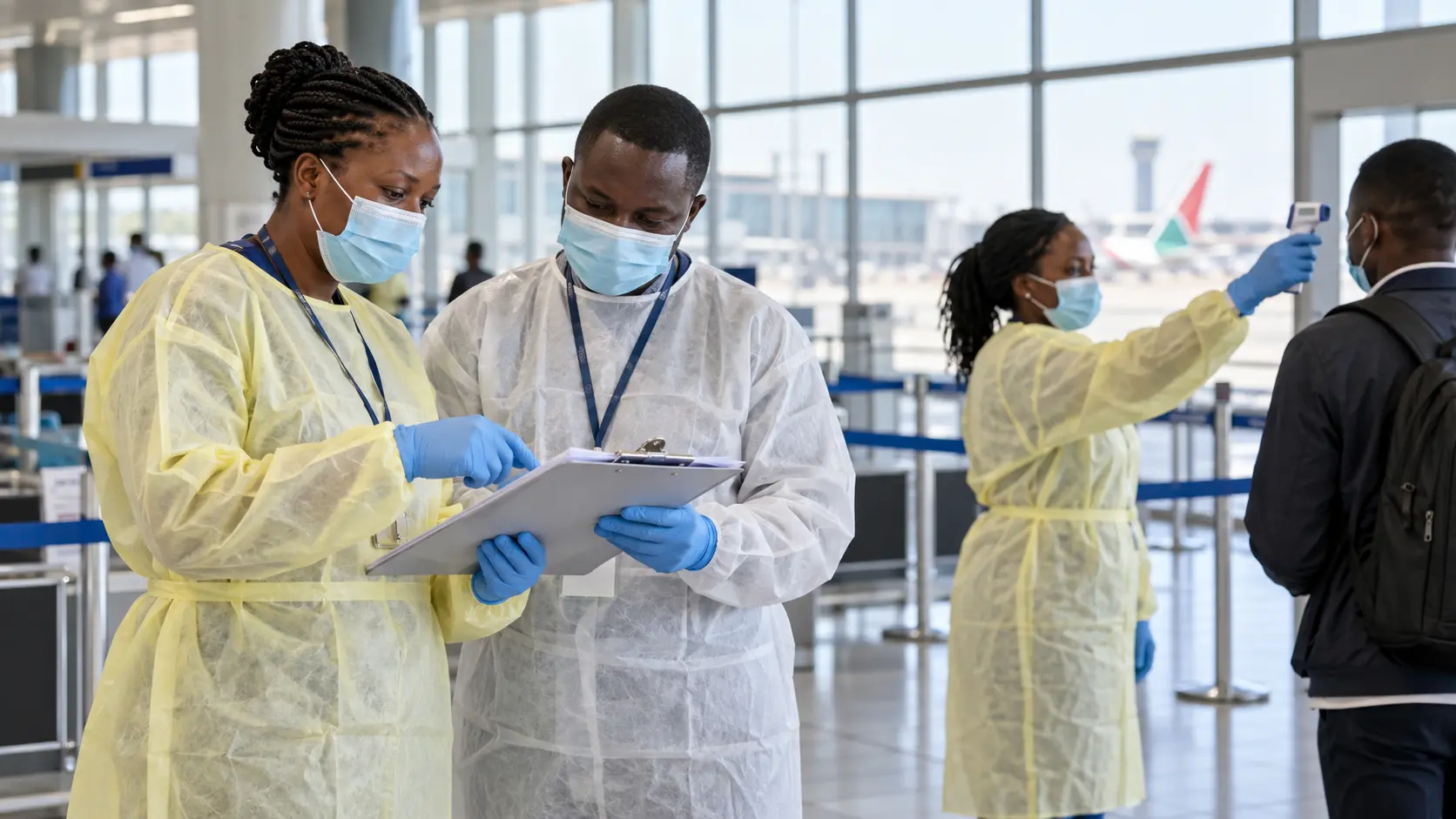
Infection-prevention measures have been strengthened at the private facility where the patient sought care, WHO says. The Nigeria Centre for Disease Control and Prevention has activated its incident-management system, while WHO is supporting contact tracing, protective equipment and infection-control work. Those measures describe the response under way; they do not by themselves prove that every exposure has already been found.
Ebola can spread through direct contact with infected blood or body fluids, contaminated objects and unsafe handling of bodies, according to Africa CDC. Symptoms can overlap with other illnesses, so neither fever nor recent travel is a diagnosis. People with relevant symptoms and a possible exposure should seek instructions from official health services promptly and avoid circulating names, photographs or unverified contact lists.
WHO advises against restrictions on travel and trade in response to the current outbreaks. Screening can support surveillance, but it cannot guarantee that every infection will be detected before symptoms appear. The practical response is accurate travel and exposure information, rapid referral, protected clinical care and cooperation with trained contact-tracing teams—not stigma or improvised quarantine claims on social media.
The public-health response and the limits of border measures
The immediate questions are now measurable: whether every listed contact can be reached and monitored, whether workers and caregivers remain protected, and whether any additional infections are found inside or outside the known chain. Until authorities publish those answers, this should be described as a confirmed imported case with an active investigation—not as community transmission, a closed investigation or a national epidemic.