Kenya’s confirmed Ebola total rose to eight on October 18, Director-General for Health Patrick Amoth said in a television interview reported by Reuters and independently by the Associated Press. The latest patient is a 49-year-old man already in quarantine after exposure linked to the first patient. Eight is the cumulative count, including the first patient who died on October 5; it is not eight additional diagnoses on Sunday.
A new diagnosis within the monitored group
Reuters reports that the man developed symptoms on October 17, was separated from others in quarantine and tested positive on October 18. Amoth described him as a patient attendant rather than a healthcare worker and said exposure to the first patient was probable. The precise route of infection remains an attributed assessment. The new diagnosis should not be added to Saturday’s three-health-worker count as though officials had identified a fourth infected clinician.
AP’s October 18 account retains a list of 130 contacts, with 128 in quarantine. Those numbers describe follow-up arrangements, not additional confirmed infections. The October 17 statement below said two people were still being traced; we have not verified a newer statement establishing their individual status. That dated detail is preserved as history rather than silently refreshed by the new case announcement.
The official assessment remains dated
Authorities continue to report no evidence of wider community transmission, according to the reviewed October 18 reporting. This is an official assessment at a specific point, not assurance that every exposure has been found. People with symptoms after possible exposure should contact health authorities for safe assessment; the Ministry of Health information line is 719. Patient privacy and cooperation with trained response teams remain essential.
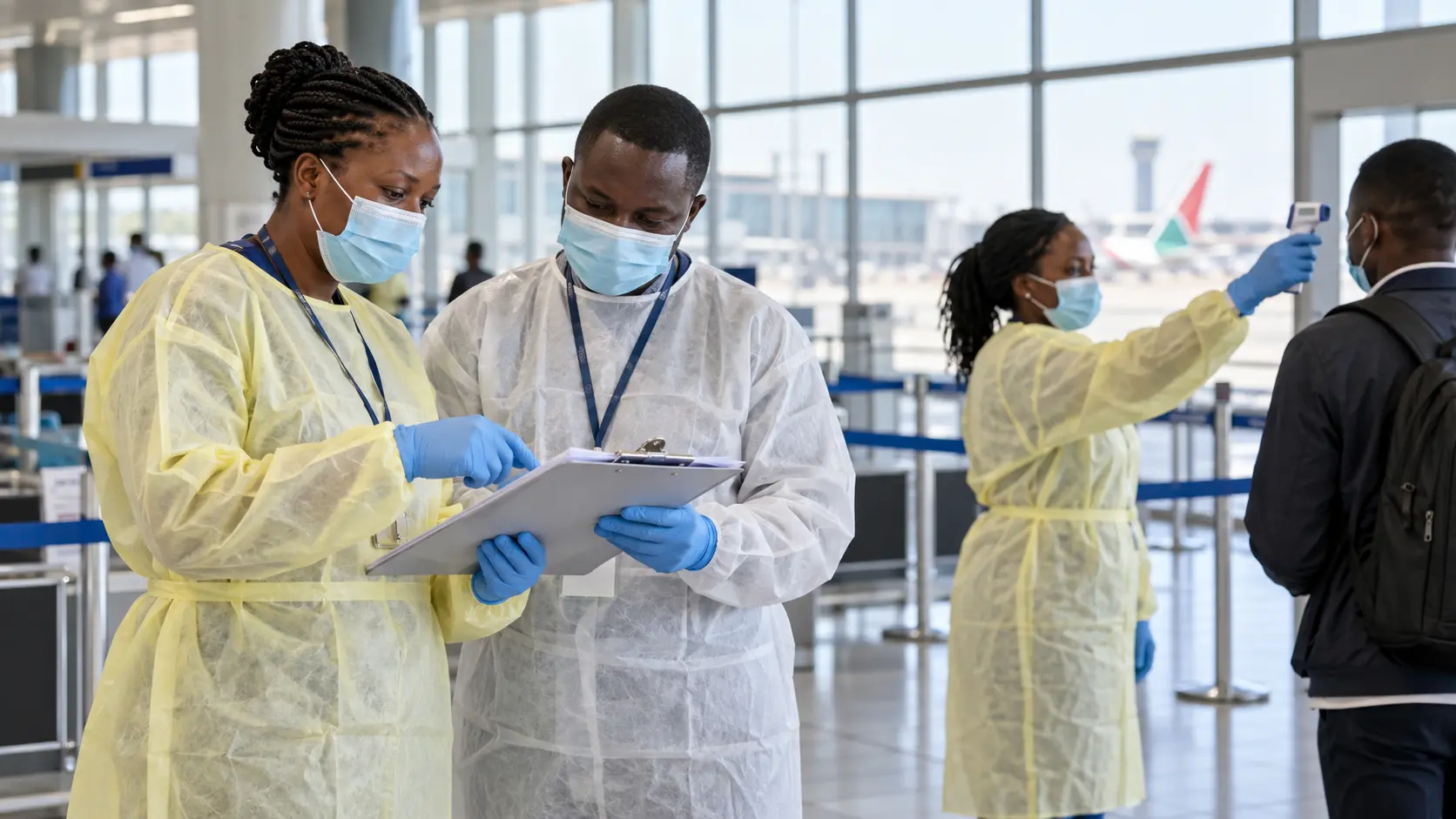
Update record, October 19 at 02:04 UTC: headline, standfirst and current fact box now reflect the additional case announced October 18. The original October 6 publication date and URL remain unchanged. The October 17 and earlier reporting below is retained as a dated record and its lower case totals are superseded. The existing AI-created image remains a general screening illustration, not a photograph of this patient or the hospital exposure.
Earlier reporting: the October 17 position
Kenya’s confirmed Bundibugyo Ebola cases rose to seven on October 17 after the Health Ministry announced four additional infections. Three of the new patients are health workers who treated the first patient; the fourth is a close male relative. The cumulative total includes the first patient, who died on October 5, rather than seven people newly diagnosed on Saturday. AP and AFP independently reported the ministry’s announcement.
Four diagnoses among known contacts
All four had been in quarantine before the new diagnoses. AFP reports that the relative entered quarantine on October 6 and the three health workers on October 9. That sequence matters: an infection detected during monitoring is different from an unexplained case found outside the known contact chain. It does not, however, establish that the investigation has reached everyone who may need follow-up.
The Star’s account of Director General for Health Patrick Amoth’s October 17 statement says fever prompted isolation and testing, with confirmation at the National Virology Reference Laboratory and the Kenya Medical Research Institute laboratory. The four are receiving supportive care. The second and third patients were reported stable; stability describes their condition at the update, not a completed recovery or a promised outcome.
The October 17 contact figures
The contact-tracing position has also changed. Authorities now report 128 of 130 listed contacts in quarantine, with two still being traced. That is approximately 98.5% of the named contact list. It replaces the October 16 position of 127 quarantined and three untraced, while keeping the distinction between people under observation and laboratory-confirmed infections: the contact list is not an additional case count.
The ministry continues to assess the risk to the general public as low and reports no evidence of community transmission. That is a dated official assessment, not a declaration that transmission is impossible. Officials also warn that further infections may be detected among quarantined contacts before their 21-day monitoring period ends. The practical test remains whether illness is recognised, patients are isolated and outstanding contacts are reached.
Protecting the people providing care
The health-worker infections make protection inside care settings an immediate part of the story. WHO’s October 12 response account described a supply handover including protective clothing, face shields, testing kits and containers for safely transporting samples. Those supplies and training support prevention and continuity of care; the new diagnoses alone do not establish how each exposure occurred, whether equipment was missing or that a particular worker or hospital breached a protocol.
WHO’s October 16 guidance explains that Bundibugyo Ebola has no licensed vaccine or specific treatment, while supportive care can improve survival. It spreads through infected blood or body fluids and contaminated materials, rather than through the air. These distinctions help explain why contact tracing and protected patient care matter. People seeking advice can use Kenya’s Ministry of Health information line, 719; suspected exposure calls for professional guidance, not online identification of patients or staff.
Earlier revision record
Update record, October 17 at 17:03 UTC (18:03 WAT): the current headline, standfirst, case count and contact figures now reflect Saturday’s four additional diagnoses. The earlier October 16 account is retained below as dated history. The original October 6 publication date and URL are unchanged. The existing AI-created airport-screening image illustrates general response work; it does not portray these health workers, patients or a documented hospital exposure.
Earlier reporting: the October 16 position
Earlier reporting, October 16: Kenya confirmed a third case of Bundibugyo Ebola virus disease, a 65-year-old woman already in quarantine after contact with the first patients. The Health Ministry announced the case on October 16, and WHO independently confirmed it that day. The reported Kenyan total at that cutoff was three confirmed cases, including one death. Those totals are superseded by the October 17 update above.
The Star’s October 16 account of the ministry statement says the woman had been quarantined since October 6 and was isolated after developing fever, a sore throat and malaise. Tests at the National Virology Reference Laboratory and KEMRI confirmed the infection, and she was transferred to an Infectious Disease Unit for supportive care. The second patient, a 39-year-old relative confirmed on October 14, was reported stable; neither patient’s eventual outcome should be assumed.
The October 16 tracing figures, now historical
In the October 16 contact figures, WHO reported that 127 of 130 people on the ministry’s contact list were in quarantine, receiving daily checks. The Star reported that the remaining three were still being traced. That was about 97.7% of the listed contacts reached and quarantined, not a percentage of Kenya’s population tested and not 127 additional Ebola cases. This is the earlier position, not today’s count.
The earlier tracing record remains useful only with its date attached. As of October 13, the ministry had listed 128 contacts and traced 113: 108 in quarantine in Kenya and five abroad, according to Kenya News Agency. Fifteen remained to be reached at that cutoff. Those figures have been superseded by the October 16 list; they are retained here as the record of what was previously known, rather than mixed into the new total.
The earlier assessment of linked cases
WHO says both later cases are linked to the first imported infection and cites the ministry’s assessment that there is no evidence of community transmission. Further cases among monitored contacts remain possible before monitoring ends. Finding illness in quarantine can allow prompt isolation, but does not establish that every exposure has been found or that the risk has disappeared. A contact is someone needing follow-up, not automatically an infected person.
The first patient travelled from the Democratic Republic of Congo through Uganda and arrived in Nairobi on October 3. WHO’s October 6 account says the patient was isolated, tested positive and died on the night of October 5; Kenya notified WHO on October 6. These are distinct travel, death and notification dates. Keeping them separate helps readers understand how the investigation developed across borders.
Earlier response figures remain historical
Our October 7 report described the initial response: 652,584 travellers screened, 267 samples tested and 4,971 health workers trained, according to Kenya’s authorities. These remain historical figures, not updated totals for today. WHO also described isolation capacity and preparedness work across high-risk counties. Readiness figures explain the response infrastructure; they do not measure how many people are infected.
WHO’s October 16 explanation says there is still no licensed vaccine or specific treatment for Bundibugyo Ebola, although trials are under way in Congo. Supportive care remains important and should not be confused with a guaranteed cure. WHO’s first-case guidance explains transmission through infected blood or body fluids and contaminated materials. Airport temperature screening cannot establish that every traveller is free of infection.
Earlier public guidance
WHO’s October 16 release says Kenya remains open without restrictions on travel, trade or public gatherings, and advises against closing borders or restricting trade. That dated position is not a guarantee about every carrier, foreign destination or later rule. Travellers should check their route’s current requirements and provide accurate health and exposure information to officials.
The ministry’s earlier public guidance asks people with concerning symptoms to seek prompt care and use the toll-free 719 information line. It also calls for respect for the affected family’s privacy. Do not circulate alleged patient identities, unverified passenger lists or claims that an acquaintance has Ebola. Cooperating with trained teams and arranging safe assessment matters more than identifying or blaming a family online.
Previous update records
Update record, October 15, 2026: this article replaced the earlier single-case headline with the second case announced on October 14 and the contact figures dated October 13. The URL and October 6 publication date are retained. The earlier statement that no second case had been announced described the October 7 updates then cited; it is no longer the current position. The existing image remains labelled as an AI-created editorial illustration, not a photograph of a patient.
Earlier revision, October 17 at 03:59 UTC: the headline and figures then reflected the third case announced on October 16 and WHO’s same-day confirmation. The October 16 tracing count was 130 listed and 127 quarantined, with three still being traced. Those figures are now historical. The original URL, October 6 publication timestamp and dated earlier figures remain preserved.