Amina J. Mohammed’s public life connects three arenas that are too often discussed separately: the practical machinery of Nigerian government, the negotiation of global development goals and the struggle to finance those goals in countries already carrying heavy debt. Since January 2017, she has served as Deputy Secretary-General of the United Nations, the organisation’s second-highest office. The position is not ceremonial. It requires her to help the Secretary-General coordinate the UN system, strengthen its development work and press governments and institutions to turn international commitments into measurable change.
Mohammed was born in 1961 and was educated in Nigeria and the United Kingdom. She began her career in architecture and project management, experience that placed her close to the difficult point where plans meet budgets, contractors, institutions and communities. That grounding helps explain the language of implementation that runs through her later work: development is not completed when leaders endorse a declaration; it is completed when a school functions, a clinic has staff and medicine, a woman can obtain finance, or a community can withstand a flood or failed harvest.
Her Nigerian policy career developed through work on poverty reduction, gender, education and the Millennium Development Goals. She coordinated Nigeria’s Task Force on Gender and Education and later advised presidents on the MDGs, including the use of debt-relief gains for programmes intended to improve public services. This period exposed the central challenge of national development planning: ambitious targets mean little unless public money is tracked, institutions cooperate and outcomes can be demonstrated beyond official speeches.
At the United Nations, Mohammed became Special Adviser to Secretary-General Ban Ki-moon on Post-2015 Development Planning. She was closely involved in the process that produced the 2030 Agenda and its 17 Sustainable Development Goals, adopted by UN member states in 2015. The SDGs widened the development conversation beyond income alone, bringing health, education, gender equality, climate, peace, institutions and inequality into one framework. Mohammed’s influence lay partly in insisting that the agenda be universal while still taking the realities of poorer and climate-vulnerable countries seriously.
She returned to federal office as Nigeria’s Minister of Environment from November 2015 until early 2017. Her portfolio included Nigeria’s climate commitments, the Great Green Wall and the long-delayed environmental restoration of Ogoniland after decades of oil pollution. The work demonstrated both the reach and the limits of ministerial authority: launching a clean-up or signing a climate plan creates responsibility, but lasting success depends on transparent procurement, scientific monitoring, community participation and continuity after one office-holder leaves.
As Deputy Secretary-General, Mohammed also chairs the United Nations Sustainable Development Group, bringing together agencies that operate across development, humanitarian and policy fields. Her recurring argument is that countries cannot deliver the SDGs through fragmented projects or borrowed money that becomes impossible to service. For African governments, that question is immediate: debt payments can compete with hospitals, schools, infrastructure and climate adaptation, even while high borrowing costs make long-term investment more expensive.
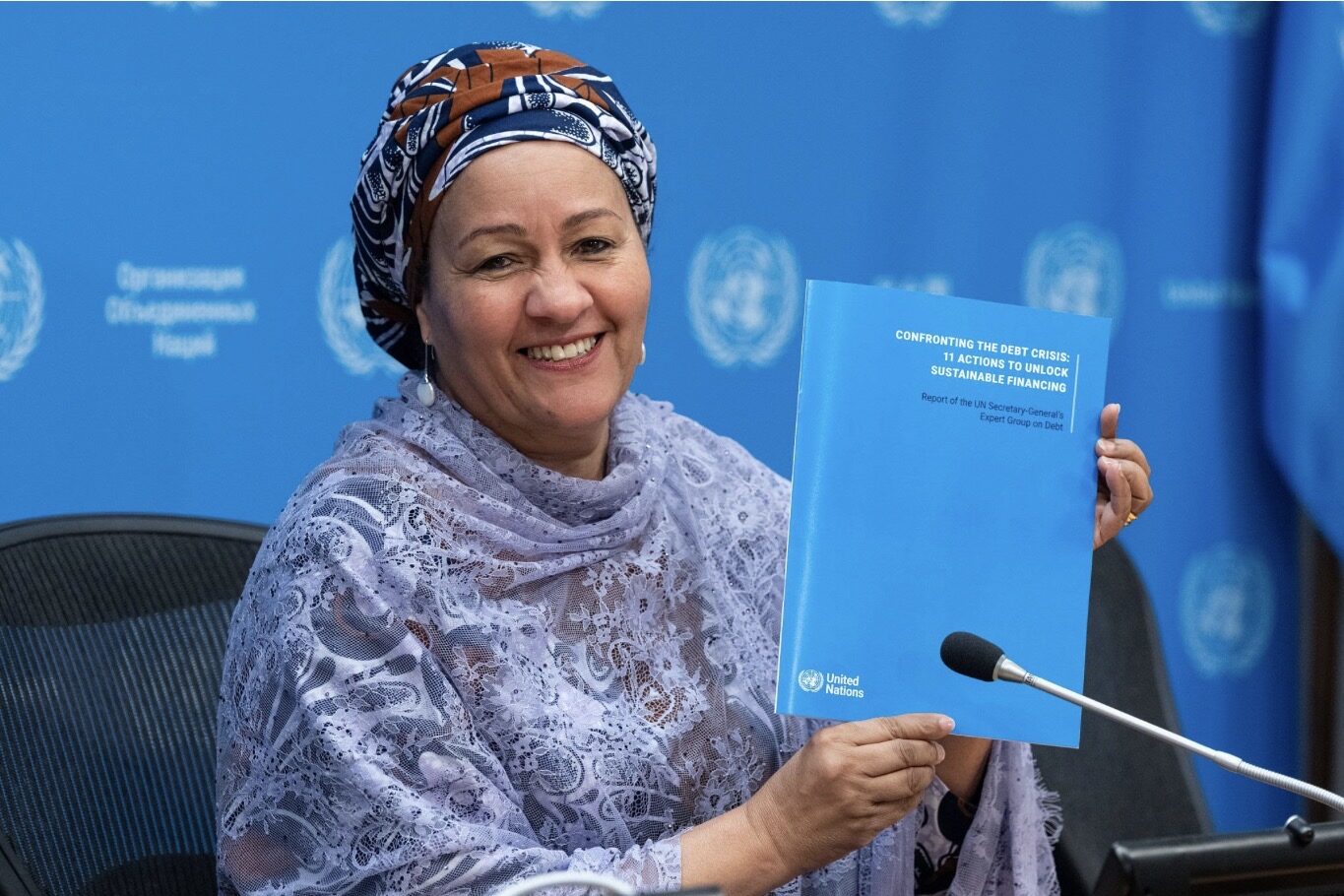
The photograph accompanying this profile captures that argument in material form. Mohammed is holding ‘Confronting the Debt Crisis: 11 Actions to Unlock Sustainable Financing,’ the report of the UN Secretary-General’s Expert Group on Debt presented around the Fourth International Conference on Financing for Development in Seville in 2025. Its proposals call for faster and fairer debt resolution, more responsible lending and borrowing, improved debt transparency, and reforms that give developing countries greater room to finance public priorities. The document is not merely a conference souvenir: it represents a contest over whether global finance will support development or continually postpone it.
Mohammed’s career is significant because it carries African policy experience into rooms where international rules are debated. Representation alone, however, is not the final measure of leadership. The harder test is whether global agreements alter financing costs, whether environmental promises survive implementation and whether citizens can see improvements in their daily lives. Her record invites both admiration and scrutiny: she has helped shape the language of sustainable development, and the unfinished task is to make that language powerful enough to change institutions, budgets and opportunity.