
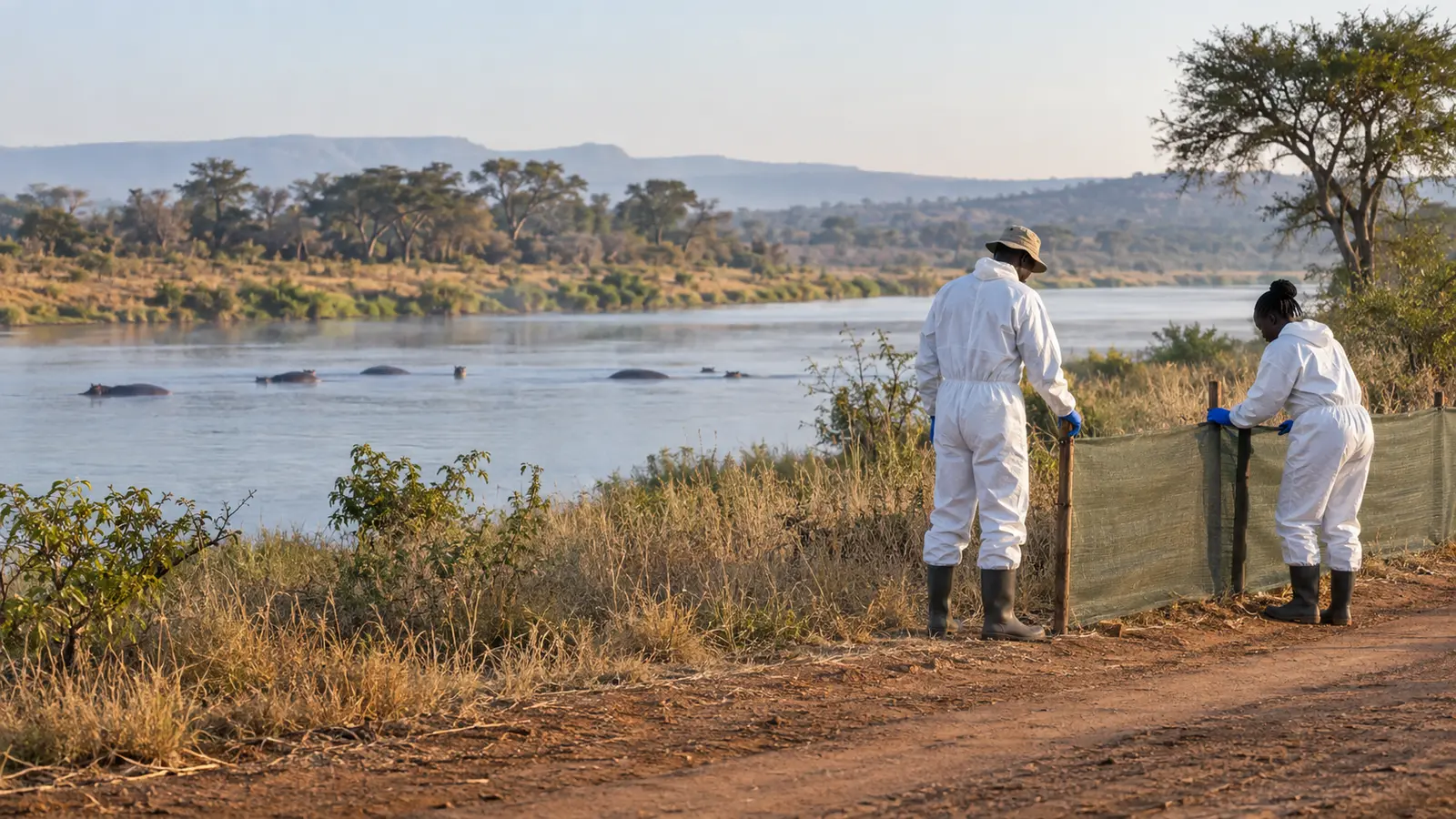
Zambian authorities have suspended hunting in part of Muchinga Province and warned residents not to handle or eat animals found dead after anthrax was confirmed in wildlife and people around the Munyamadzi and Nabwalya areas of Mpika District. The response includes health treatment, surveillance, carcass controls and roadblocks intended to stop potentially contaminated meat from leaving the area.
The latest national account from the Disaster Risk Management Division says 46 hippos, eight elephants, five buffaloes and one crocodile have died since July—a total of 60 wild animals. National coordinator Norman Chipakupaku said 12 people became infected after residents consumed meat from wildlife carcasses and were receiving treatment. He said no human death had been reported.
National and provincial totals do not yet match
A separate on-the-ground update from Muchinga Provincial Health Director David Silweya put the number of patients at about 14 and said they were stable in health facilities. That account also cited more than 26 dead wild animals in the Nabwalya area. The two official tallies may reflect different reporting times, geographic scopes or case definitions, but authorities have not yet published a reconciliation.
For that reason, this report does not collapse the figures into a false single total. The national update supports a minimum of 12 people under treatment and a cumulative wildlife toll of 60 in the wider response area. The provincial statement indicates that the patient count could be higher. Surveillance and additional laboratory work are still under way, so both human and animal totals may change.
The government initially described suspected anthrax and environmental pollution across Mpika, Lavushimanda and Shiwang’andu districts on 10 September. Officials said roughly 40 animals had died and 11 people were suspected to have been affected at that stage. Later field reporting from Mpika described laboratory confirmation among animals and people, marking a material change from the first alert.
The immediate response
Authorities have temporarily stopped hunting in the affected game-management area while they determine how far the outbreak extends. Wildlife police and other security personnel are securing carcass sites and operating checkpoints to prevent meat from being transported to other communities or markets. An aircraft and health personnel were also sent to support sampling, treatment and assessment.
Residents have been told not to consume, sell, distribute, butcher or handle meat from an animal that died suddenly or for an unknown reason. Anyone who has eaten such meat or touched a suspicious carcass should contact local health, veterinary or disaster-management authorities. The warnings apply even when meat looks or smells normal because anthrax contamination cannot be ruled out by appearance.
Anthrax is caused by the spore-forming bacterium Bacillus anthracis. Its spores can persist in soil for long periods and infect grazing animals when environmental conditions expose them. People can become ill after skin contact with infected animals or animal products, after eating contaminated meat, or less commonly after inhaling spores. It does not normally spread from person to person like influenza or measles.
Why handling a carcass is dangerous
The outbreak also exposes a livelihood problem. Chipakupaku said local people consumed the carcasses because wildlife meat forms part of their food supply. Containment therefore depends not only on enforcement but on clear risk communication, access to safe food, rapid diagnosis and treatment, and support for communities asked to stop hunting or using carcasses.
Zambia experienced a large anthrax outbreak in 2023, when the government reported infections across multiple provinces and linked several human cases to meat from dead animals. That history gives health and veterinary services experience with vaccination, surveillance and safe disposal, but it does not establish the size or eventual course of the current event.
The next reliable measures of the outbreak will be a reconciled human case count, laboratory results from additional animals, a mapped geographic boundary, safe disposal of known carcasses and evidence that contaminated meat has not moved beyond the control area. Until those are published, the hunting suspension and public warning should be treated as active precautions rather than proof that the outbreak has already been contained.