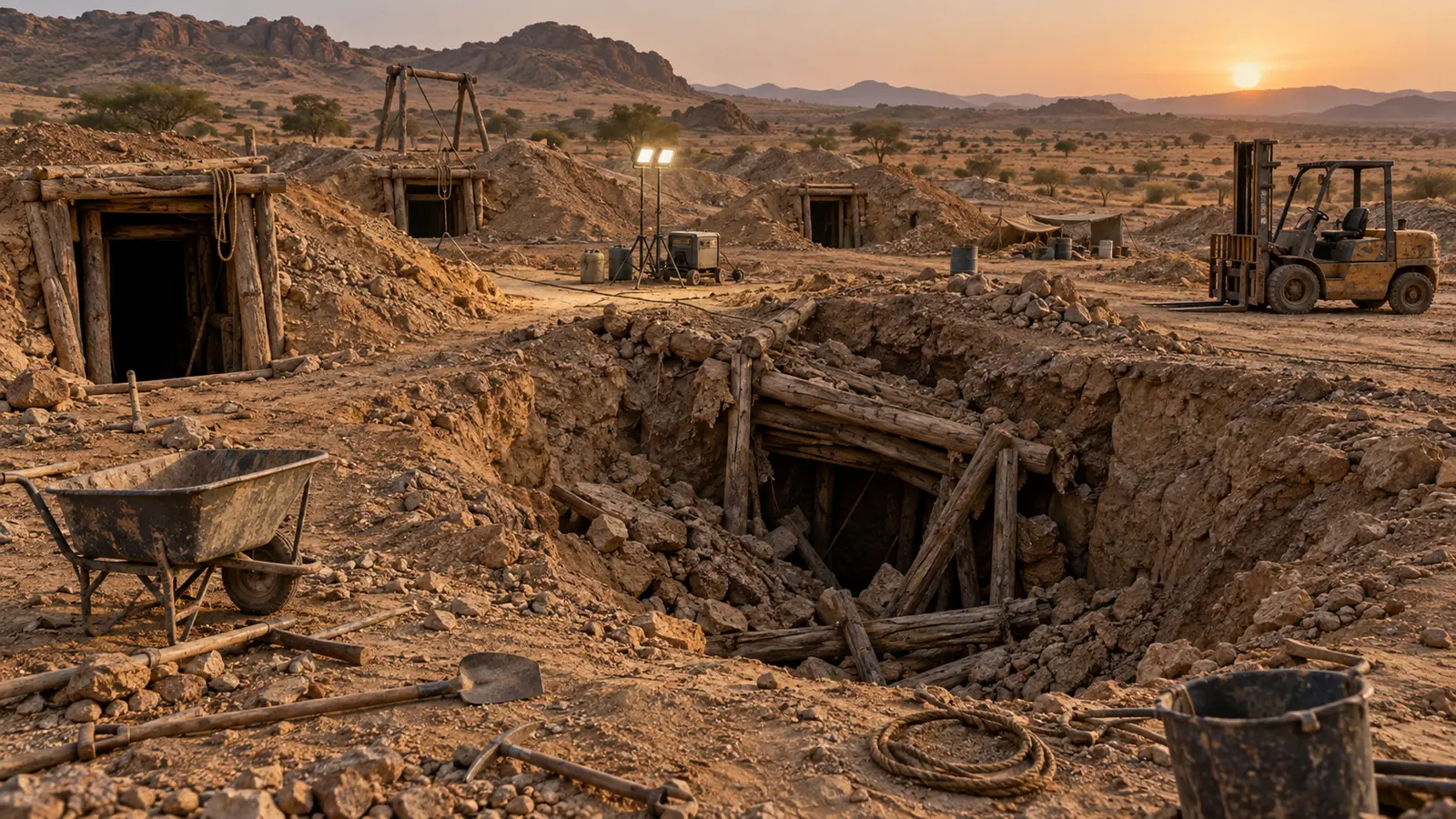
Local responders in Sudan's West Kordofan state reported on Wednesday, 16 September 2026, that 82 bodies had been recovered after the collapse of an informal gold mine near El-Nahud, also written as Nuhud. Dozens of people were still described as missing, leaving the final toll uncertain as rescue work continued at the al-Zara, or al-Zaraa, site.
The Associated Press attributed the updated count to Suleiman Abu Hmeida, a member of the area's Emergency Response Rooms, a volunteer network that has supported communities during Sudan's war. An administrator in the area also gave Agence France-Presse a toll of 82. Those are locally reported figures from a difficult-to-access, Rapid Support Forces-controlled region; they are not a completed national identification record.
A toll that rose during the rescue
Earlier on Wednesday, the Sudan Doctors Network said at least 67 people had been killed. Survivors and other local groups offered still different preliminary figures as bodies were brought out. The reports should therefore be read as successive snapshots of an active recovery operation, not competing totals that can be added together.
Witnesses told AP that several connected underground shafts gave way in succession. One survivor said rescuers were working at depths greater than 30 metres with very limited equipment, including a single forklift. The Kordofan Observatory said the linked workings extended for more than a kilometre, illustrating why locating miners and recovering casualties could take time.
Accounts also differ on when the collapse began. Survivors cited by AP placed it on Tuesday evening, 15 September, while the Kordofan Observatory said the failure started on Sunday. The remoteness of the site, damaged communications and the continuing conflict make rapid, independent verification unusually difficult. This report uses the latest toll while preserving the conflicting timeline rather than presenting either account as settled fact.
Why the accounts differ
No reviewed report established a final technical cause. The descriptions of adjoining shafts collapsing indicate a cascading failure, but a formal engineering investigation would be required to determine whether ground conditions, excavation methods, structural supports or another factor initiated it. The disaster should not be assigned to a person or armed group without evidence.
The mine lies in territory controlled by the paramilitary Rapid Support Forces, which is fighting the Sudanese Armed Forces in a war that began in April 2023. Control of the area explains the access and reporting environment; it does not by itself establish responsibility for the collapse. West Kordofan has repeatedly shifted within the conflict's wider military and commercial geography.
Gold in Sudan's war economy
Gold is one of Sudan's most important sources of income and foreign currency. AP reported earlier in 2026 that the country produced about 70 tonnes in 2025, while much of the sector operates through small-scale or artisanal mining. Informal miners often work without dependable shaft reinforcement, ventilation, protective equipment or an emergency service capable of reaching deep workings quickly.
The immediate priorities are rescue, medical support, identification and a transparent accounting of those missing. The longer-term test is whether authorities and whoever exercises effective control can improve mine registration, inspections and rescue capacity without cutting off livelihoods on which families depend. Any confirmed revision to the toll, the number rescued or the cause will require a further update.