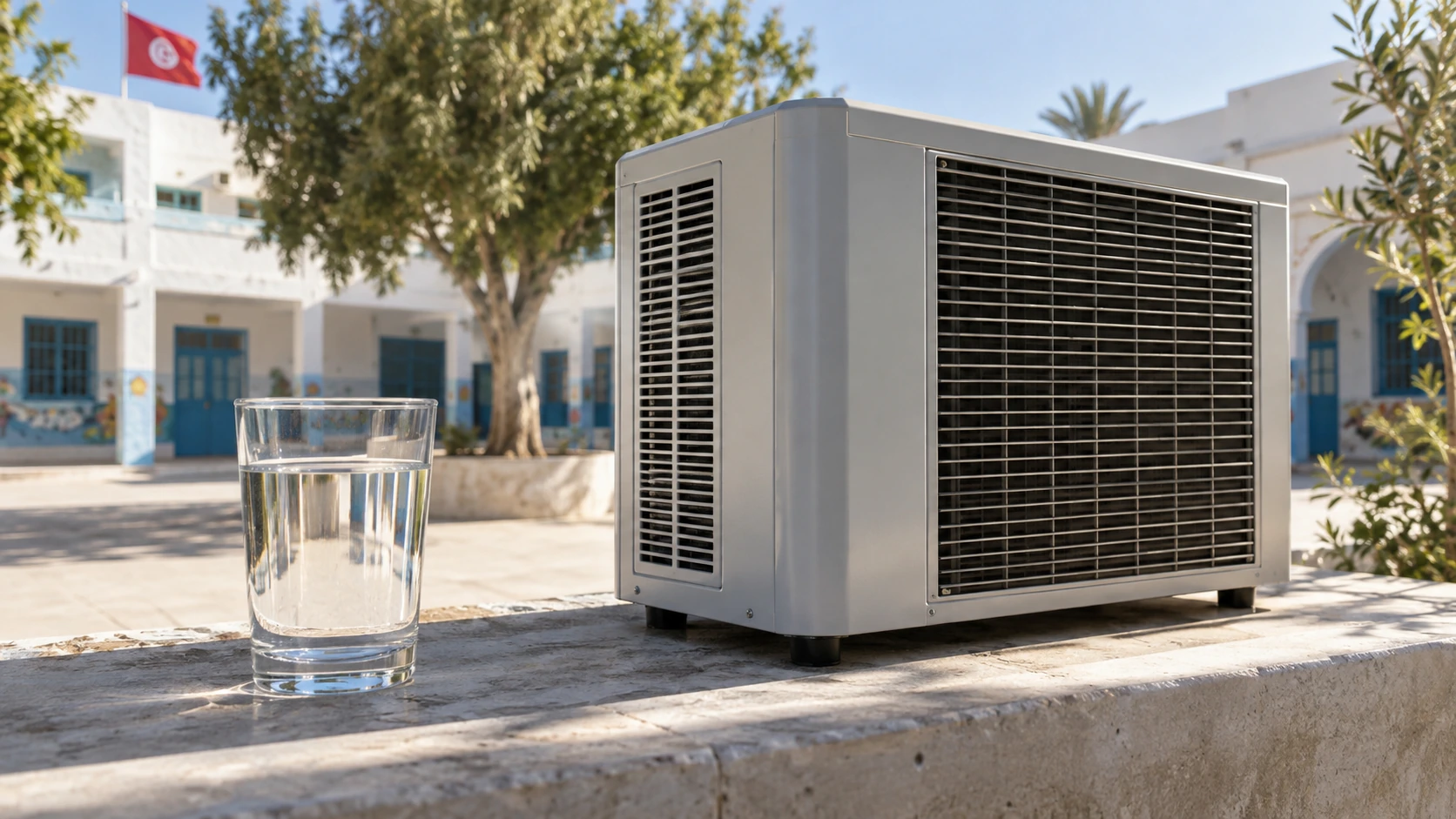
Water appearing on a cool surface is familiar; using that process as a drinking-water business is a more ambitious undertaking. Kumulus, which operates from Tunisia and France, develops machines that collect moisture from air and treat the resulting water. The proposition is local production where drinking water might otherwise arrive in bottles.
The company’s own history names Iheb Triki and Mohamed Ali Abid and places their initial inspiration during a 2020 camping trip in the Tunisian desert. It dates the business to 2021 and the Amphore product launch to 2023. This is an established development story, rather than a newly discovered natural phenomenon.
Kumulus describes a process of drawing in humid air, cooling it to obtain liquid water, filtering the water and adding minerals. These are combined engineering functions. The machine does not manufacture hydrogen and oxygen, and an absence of a piped-water connection does not mean an absence of energy consumption.
The maker explicitly acknowledges that output depends on temperature and humidity. Its published technology page describes more favourable performance in warmer, sufficiently humid conditions. That qualification is essential: a coastal location and a very dry inland site cannot be assumed to yield the same amount of water from an identical machine.
A buyer’s most useful comparison would be cost per litre delivered under the conditions at the actual site. Electricity, replacement filters, servicing and downtime belong in that calculation alongside the purchase price. A headline daily capacity is informative only when its test conditions accompany it.
For a school or clinic, responsibility for the unit must also be clear. Someone needs to maintain it, record faults and arrange appropriate water-quality checks. An attractive machine can create an expectation of safe water every day; the operating arrangements must be strong enough to support that expectation.
There may be a business case where bottled-water delivery is expensive or inconvenient. That case should be compared with other feasible options, including improvements to existing supply. Environmental claims likewise need a comparison that includes local power and consumables. Moving water production nearer to the user changes the calculation rather than settling it automatically.
Kumulus is interesting because it makes an unconventional water source into a product that can be evaluated. The inspiring question is not whether a machine can perform magic in a desert. It is whether Tunisian engineering can deliver a dependable, competitively priced service in the locations where condensation makes practical sense.