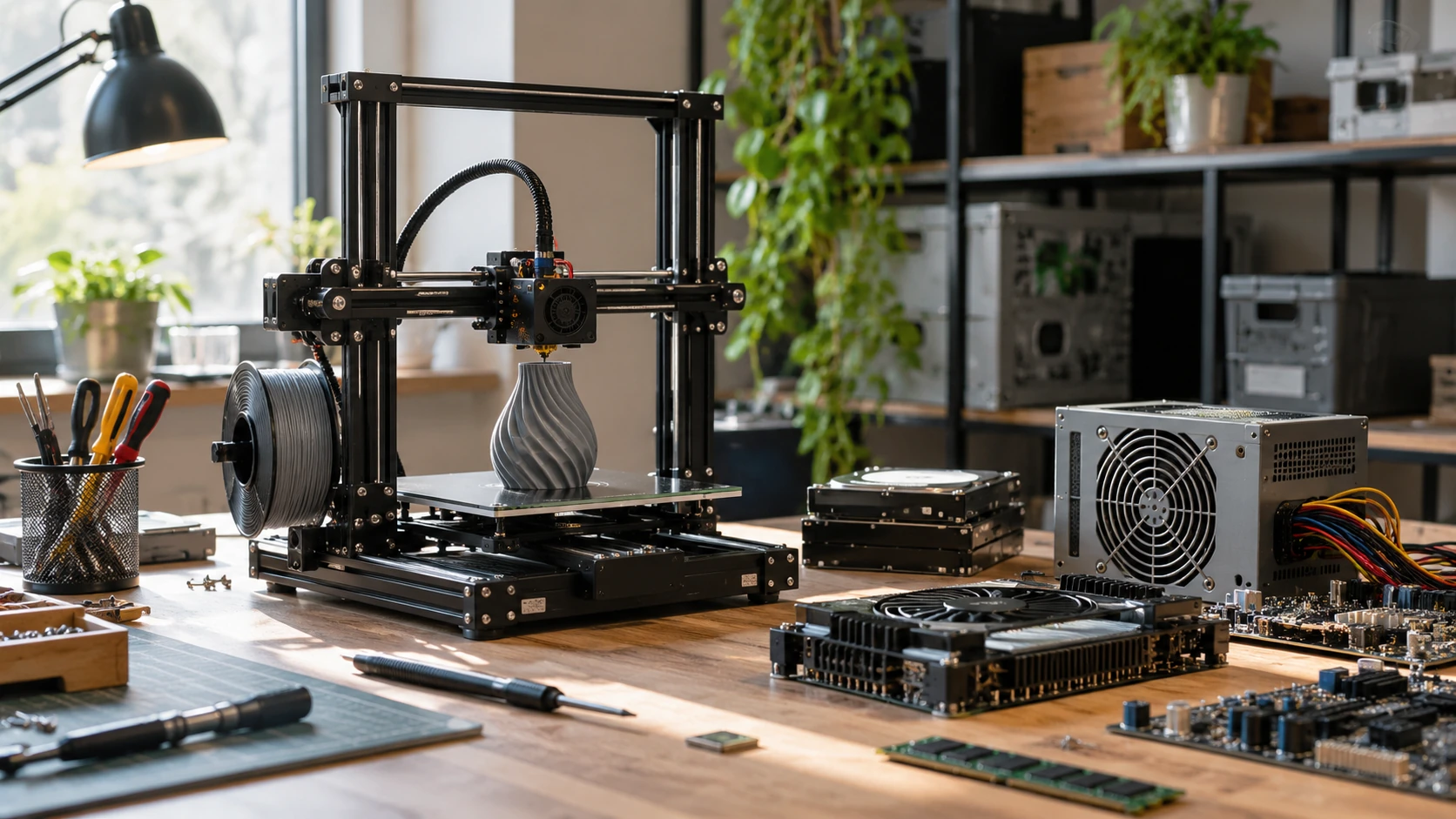
At WoeLab in Lomé, electronic scrap became the starting material for an unusual manufacturing experiment. The W.Afate project assembled a working 3D printer using recovered equipment alongside purchased components. The striking idea was not that rubbish magically produced objects, but that a local team could reconstruct a sophisticated tool from parts it understood.
In a published interview with Tea After Twelve, project participant Josué Tchirktema traced the effort to a 2012 workshop assembling an imported RepRap kit. The team then attempted a version using locally available electronic scrap. This was a deliberate exercise in adaptation, with an existing open-source design providing a foundation.
Tchirktema described reusing parts from computers, scanners and printers, while buying electronics that could not be recovered. A digital model directs the machine’s movements as it builds a small object from printing material. The team’s achievement should not be confused with a machine that converts mixed electronic waste directly into finished plastic goods.
The interview also described a practical repair for a farmer and efforts to introduce the technology to schools. These are historical accounts of particular activities, rather than evidence of the project’s present production volume. They show the kinds of uses a small fabrication workshop can explore: replacement parts, demonstration models and prototypes.
For a repair business, waiting for one unavailable component can leave an otherwise useful machine idle. Local fabrication is interesting because it may shorten that wait. The first question, however, must be whether the proposed replacement is suitable for the load, heat and wear it will experience. A successful print is not automatically a dependable mechanical part.
Schools could use this approach to connect design with consequences. A pupil can draw a shape, see where it fails to fit and revise it. Learning to measure a component accurately is an achievement even when the first object is unusable. A workshop becomes educational when those decisions are explained and recorded.
The business would still need printing material, electricity, calibration and customers. Recovered parts can reduce some costs while increasing the time spent checking and adapting them. A transparent price should include that labour. Calling the inputs waste must not make the maker’s skill disappear from the calculation.
W.Afate remains an arresting example of technological ownership. The ambition is larger than assembling a cheaper machine: it is to make equipment comprehensible enough that people can alter it for their own needs. Lomé’s experiment gives a concrete form to that ambition, one salvaged mechanism and one carefully revised design at a time.