
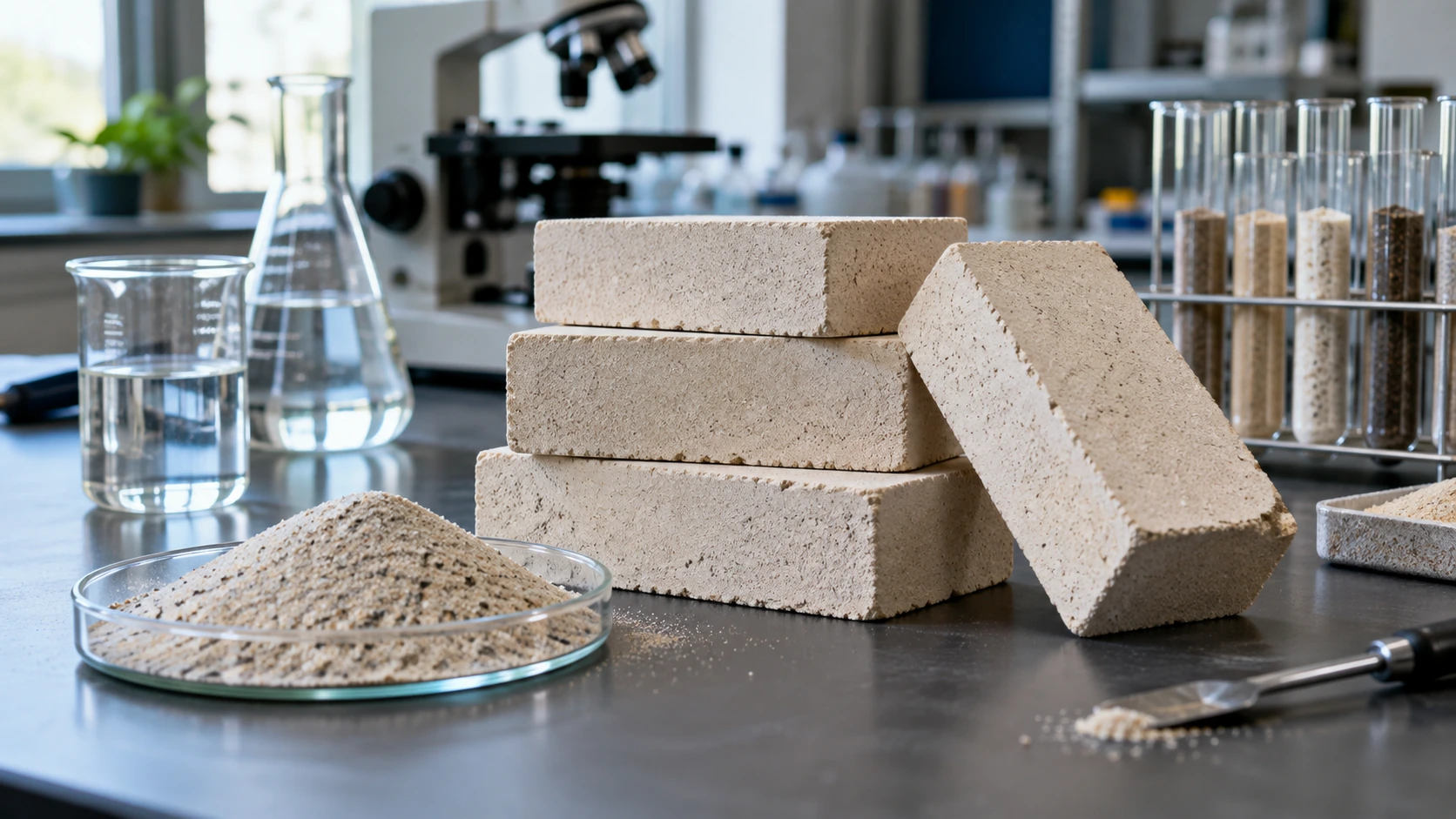
Few building-material stories have an opening as arresting as this one: researchers used human urine in a process that bound sand into bricks. The University of Cape Town presented the work in October 2018, with civil-engineering student Suzanne Lambert, researcher Dyllon Randall and fellow student Vukheta Mukhari among the people involved.
The process used bacteria that produce the enzyme urease. Breaking down urea helped create conditions in which calcium carbonate formed and cemented the sand grains together. UCT described this as microbial carbonate precipitation. The brick was grown in a mould at room temperature rather than fired in a kiln.
The university acknowledged earlier work using synthetic urea solutions. Its report located this experiment’s distinctive contribution in the use of real human urine and its relationship to resource recovery. That context makes the scientific achievement clearer than a claim that the team invented every part of biological construction.
The researchers were also interested in recovering fertiliser products. Their account discussed collection logistics and social acceptance alongside material tests. This was a laboratory development with promising possibilities; the cited report does not establish that houses across South Africa are now being built with these bricks.
A building product has to satisfy more than an intriguing laboratory demonstration. Consistent strength, durability, moisture behaviour and appropriate approval would need to be established for a proposed use. The right question is which application the material can meet reliably, rather than whether a single specimen looks like an ordinary brick.
Collection could become as important as chemistry. Separating a useful waste stream, transporting it and running treatment equipment would require an organised service. A serious economic assessment should include those tasks, together with the value of any recovered products. Describing an input as waste does not remove the cost of obtaining it in a usable form.
Public acceptance should be approached through evidence and explanation. People are entitled to know how a material is processed and tested before it enters a home. A dramatic headline may draw attention, but transparent performance information would do more to help an unfamiliar construction product earn a place in the market.
The experiment’s lasting provocation is that sanitation and manufacturing need not be considered entirely separate systems. UCT’s researchers asked whether substances leaving one process could become useful inputs to another. Turning that possibility into an economical service would be a substantial next achievement—and one worth describing with the same precision as the first brick.