A Somali mother’s three-day journey with her sick child has put a human scale on a national malnutrition emergency. Associated Press reporting published on Monday, October 12, describes how Halima Abdullahi Ibrahim carried her three-year-old daughter, Asho Hassan Abdi, nearly 90 kilometres from their village to Kismayo Referral Hospital because the specialised care the child needed was not available closer to home.
The journey and hospital observations took place on September 22, not on the date the report was published. At the hospital’s stabilisation centre, clinicians diagnosed Asho with oedema associated with severe acute malnutrition. Swelling can make the seriousness of malnutrition less visually obvious than wasting, which is one reason assessment by trained health workers matters.
A journey measured in days, not minutes
Halima and Asho are named in the AP account, but their experience should not be treated as a symbol stripped of its particulars. The immediate facts are a child who needed urgent care, a mother who had to travel for days to obtain it and a health system receiving more severely malnourished children than many families can easily reach.
Jubbaland Health Minister Ismail Garas told AP that Kismayo Referral Hospital admitted 152 children with severe acute malnutrition in August and that four of them died. Those are hospital figures for one month and one facility; they are not a national death toll, and they do not measure children who never reached care.
The national estimate comes from the Integrated Food Security Phase Classification, or IPC, analysis released on September 23. It projects that 1.92 million children aged six to 59 months will suffer or are expected to suffer acute malnutrition and require treatment during the 12-month period from July 2026 through June 2027.
What the 1.92 million estimate actually means
That 1.92 million figure is therefore a cumulative treatment-needs estimate across a year, not a count of children confirmed ill on October 12. It includes about 433,000 children projected to experience severe acute malnutrition, the form associated with the greatest risk of death. The same analysis estimates that 157,000 pregnant and breastfeeding women will suffer or are expected to suffer acute malnutrition during the period.
Food insecurity is the larger setting. The IPC projects 5.4 million people will face Crisis-level hunger or worse from October through December 2026, including 1.5 million facing Emergency conditions or worse. These classifications describe severity and the need for action; they do not mean every household within a district has an identical experience.
Nineteen areas were classified in IPC Acute Malnutrition Phase 4, or Critical, for the current analysis period. Internally displaced people in Belet Weyne were projected to reach Phase 5, Extremely Critical, during the projection period. The separate risk-of-Famine finding for displaced people in Baidoa was based on data collected in April, and the agencies said a follow-up assessment was planned for October. That risk must not be reported as a confirmed present-day famine declaration.
The burden is uneven. IPC says more than half of the estimated cases are concentrated in southern Somalia, where disease outbreaks, acute food insecurity, poor water and sanitation, and reduced access to health and nutrition services reinforce one another. The joint government and UN release says nearly 62 per cent of the burden is among rural populations.
Southern Somalia carries much of the burden
Distance turns those national pressures into a medical access problem. A stabilisation centre can provide therapeutic care after a family arrives, but transport costs, insecurity, lost income and the physical challenge of carrying a sick child can delay that arrival. Kismayo also receives families displaced from surrounding areas, increasing pressure on clinics, hospitals and informal settlements.
Expected El Niño-related flooding creates an additional risk during October to December. Agencies warn that flooding could displace families, contaminate water sources, increase disease and cut off roads to treatment. It is a projection that supports preparedness—not proof that every forecast flood impact has already occurred.
Funding shortages narrow the response at the same time needs are rising. A Jubbaland official told AP that many displaced families in the Luglow settlement had received no humanitarian assistance since 2023 because agencies lacked funds. That statement describes the official’s account of local conditions; it is not a complete audit of every organisation working in the settlement.
The response must reach families before the hospital
IPC’s recommended response is broader than emergency feeding alone: scale up food, nutrition and health services; restore closed primary-care and nutrition sites; protect livelihoods; and improve safe water, sanitation and hygiene. Community health workers and local leaders also matter because early screening and referral can reduce the distance between the first warning signs and specialised treatment.
For readers and donors, the central lesson is not that one journey represents every Somali family. It is that national projections become more dangerous when treatment is separated from children by days of travel. The next evidence to watch is the October follow-up assessment, the extent of flooding, whether closed services reopen, and whether treatment capacity expands in southern and displacement-affected areas.
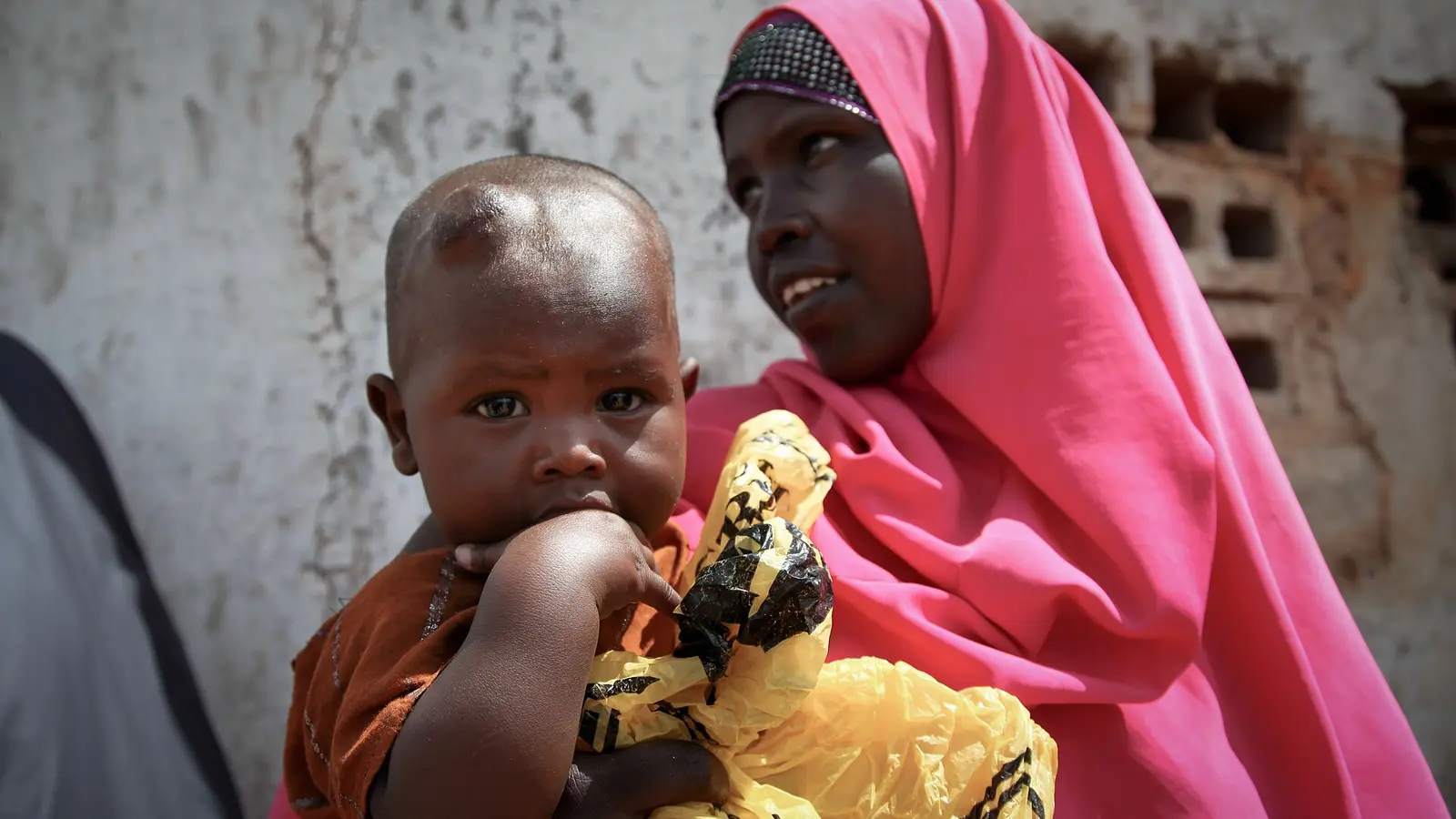
The lead image is an authentic but archival photograph made in Kismayo in August 2013. It shows a woman and child waiting for medical care at a free clinic; it does not depict Halima, Asho, the September 2026 hospital visit or the current malnutrition caseload. The date and context are stated so the photograph is not mistaken for documentary evidence of this specific case.