At least 139 migrants have died and 84 remain missing after a boat capsized off Djibouti, the International Organization for Migration said on Sunday, October 11. The UN agency raised the confirmed death toll after 30 additional bodies were recovered while Djiboutian search and rescue operations continued.
The disaster happened near Guehere, north of the port town of Obock, during the night of October 8–9, according to survivor accounts cited by IOM. The vessel was travelling from Djibouti toward Yemen across the waters linking the Gulf of Aden and the Red Sea. The event date is therefore two days earlier than the agency’s updated announcement.
The updated figures reconcile 305 people
IOM’s latest accounting says the boat carried 305 people: 139 confirmed dead, 84 still missing and 82 survivors. Those three figures add up to the stated number aboard. All 82 survivors were Ethiopian nationals, the agency said.
The figures changed rapidly as recovery teams worked. IOM’s first Sunday account listed 109 bodies, 116 people missing and more than 80 survivors. Its later update reported that 30 more bodies had been recovered and gave the reconciled totals of 139 dead, 84 missing and 82 surviving. Earlier reports should not be presented as the current toll.
IOM said it was providing healthcare, psychosocial support, food and other assistance to 64 survivors at its migrant response centre in Obock. Djiboutian authorities were continuing search and recovery work, caring for survivors and arranging burials for those whose bodies had been recovered.
What is confirmed—and what is not
The reviewed official update confirms that the vessel capsized, but it does not establish why. It does not attribute the disaster to a named operator, a mechanical defect, weather or a deliberate act. Those questions require survivor testimony and an official maritime investigation; they should not be filled with inference.
The confirmed toll may still change because 84 people remain unaccounted for. A missing person is not automatically a confirmed death, even when survival becomes less likely with time. Responsible reporting must keep the recovered dead, the missing and the survivors in separate categories.
The crossing is part of what IOM calls the Eastern Route. Migrants from Ethiopia, Somalia and elsewhere in the Horn of Africa travel through Djibouti, cross the Bab el-Mandeb Strait to Yemen and often hope to continue to Saudi Arabia or other Gulf states for work and security.
The Eastern Route through Djibouti
That route runs in both directions. People attempt the north-eastward journey toward Yemen and the Gulf, while conflict and hardship in Yemen have also pushed people across the sea toward Djibouti. The movement continues despite armed conflict, exploitation, extreme heat, dangerous overland travel and repeated shipwrecks.
IOM says poverty, insecurity and climate pressures are among the forces driving people to take the journey. Those conditions do not make every traveller’s circumstances identical, and the agency has not published individual histories for the people aboard this vessel. The shared fact is that they entered a migration corridor with severe, well-documented risks.
More than 900 migrants died or went missing along the route in 2025, according to IOM’s Missing Migrants Project. The agency also reported that the number attempting the journey increased by 18 per cent that year, underscoring that awareness of danger has not removed the economic and protection pressures behind the crossings.
A worsening record of deaths and disappearances
This was not the first major loss on the route in 2026. In March, IOM reported nine deaths and 45 people missing after another boat carrying more than 300 migrants sank while travelling from Djibouti toward Yemen. The October disaster is now among the deadliest shipwrecks recorded on the Eastern Route.
The nationalities of the survivors are known, but the later IOM update did not publish a full revised breakdown of the 139 recovered bodies by age, sex or nationality. An earlier tally identified children among the dead. Families need reliable identification and notification processes, not speculation based on incomplete lists.
The next essential facts are the identities of those recovered, the status of the missing, the condition and wishes of survivors, the ownership and operation of the boat, the number it was designed to carry, the weather and sea conditions, and any evidence about how the vessel came to capsize. None of those unresolved issues should be reported as settled.
What must be established next
For governments and donors, the immediate obligations are rescue, medical and psychological care, dignified recovery and identification, and communication with families. Longer-term prevention requires safer regular pathways, protection from smugglers and traffickers, and economic and security policies that address why people accept such extraordinary risk.
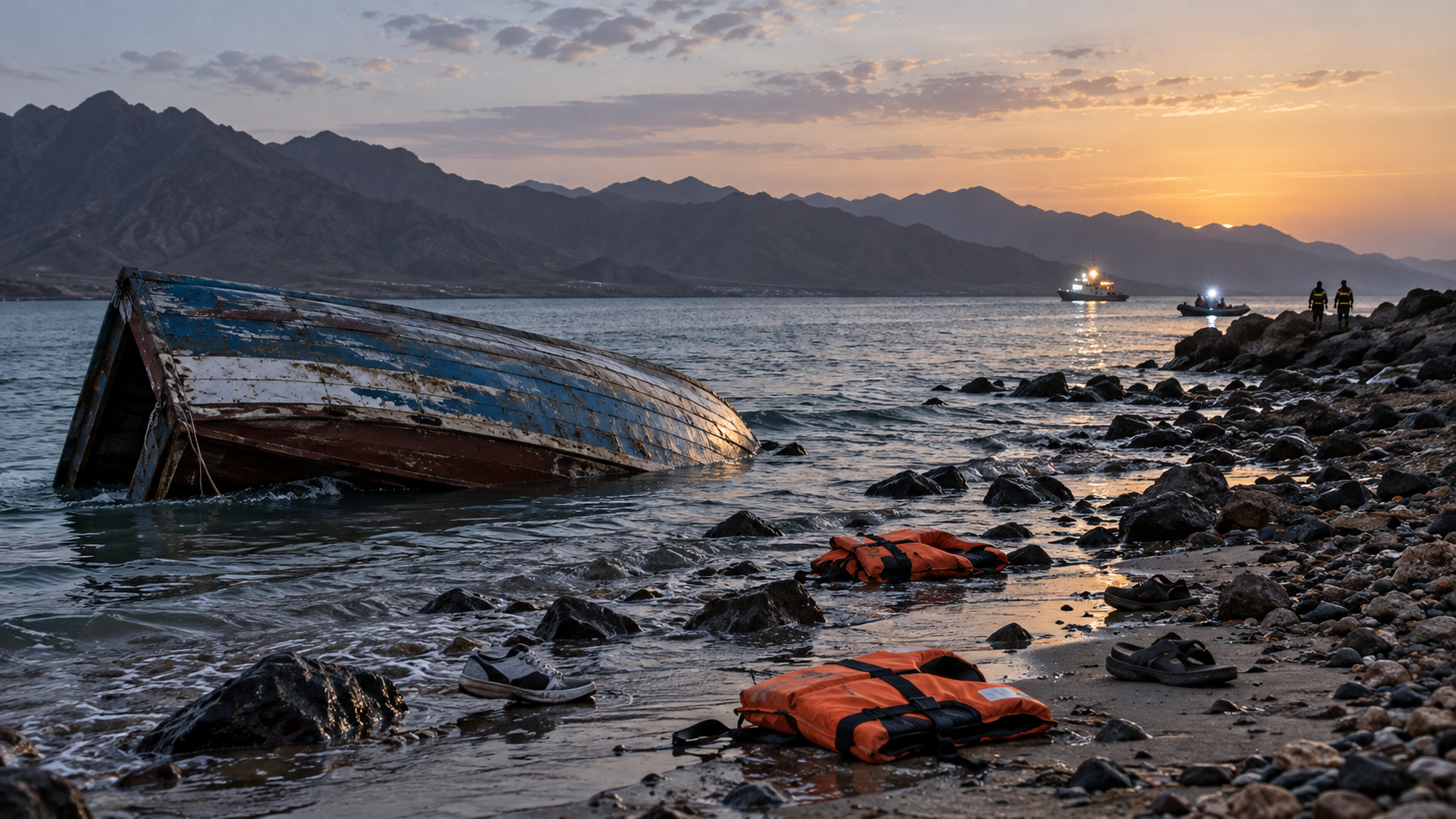
This report uses a clearly labelled AI-created symbolic editorial image because no suitably licensed documentary photograph of this specific October 8–9 disaster was available for local publication. The image contains no real victim, survivor or rescue worker and must not be read as visual evidence of the event.