Production design makes time and social circumstance visible before a character explains them. The current festival programme for Dear Ajayi credits Abisola Omolade with production design and places the story in southwestern Nigeria in the 1990s. Those two facts provide a useful starting point for discussing the department’s responsibility; they do not amount to a review of sets we have not examined in the completed film.
Credits from another recent film underline the collaborative nature of the work. Cannes names Jennifer Anti and Pablo Anti for production design on My Father’s Shadow, a story set during Nigeria’s 1993 election crisis. Naming practitioners helps move discussion beyond the director and cast, towards the people responsible for constructing a film’s material world.
Research has to be more specific than choosing a decade. A household’s location, income, occupation and habits affect what it owns and how it uses space. An object might be newly bought, inherited or repaired several times. The date when something was manufactured is therefore only one clue; the designer also asks why this particular person would still have it.
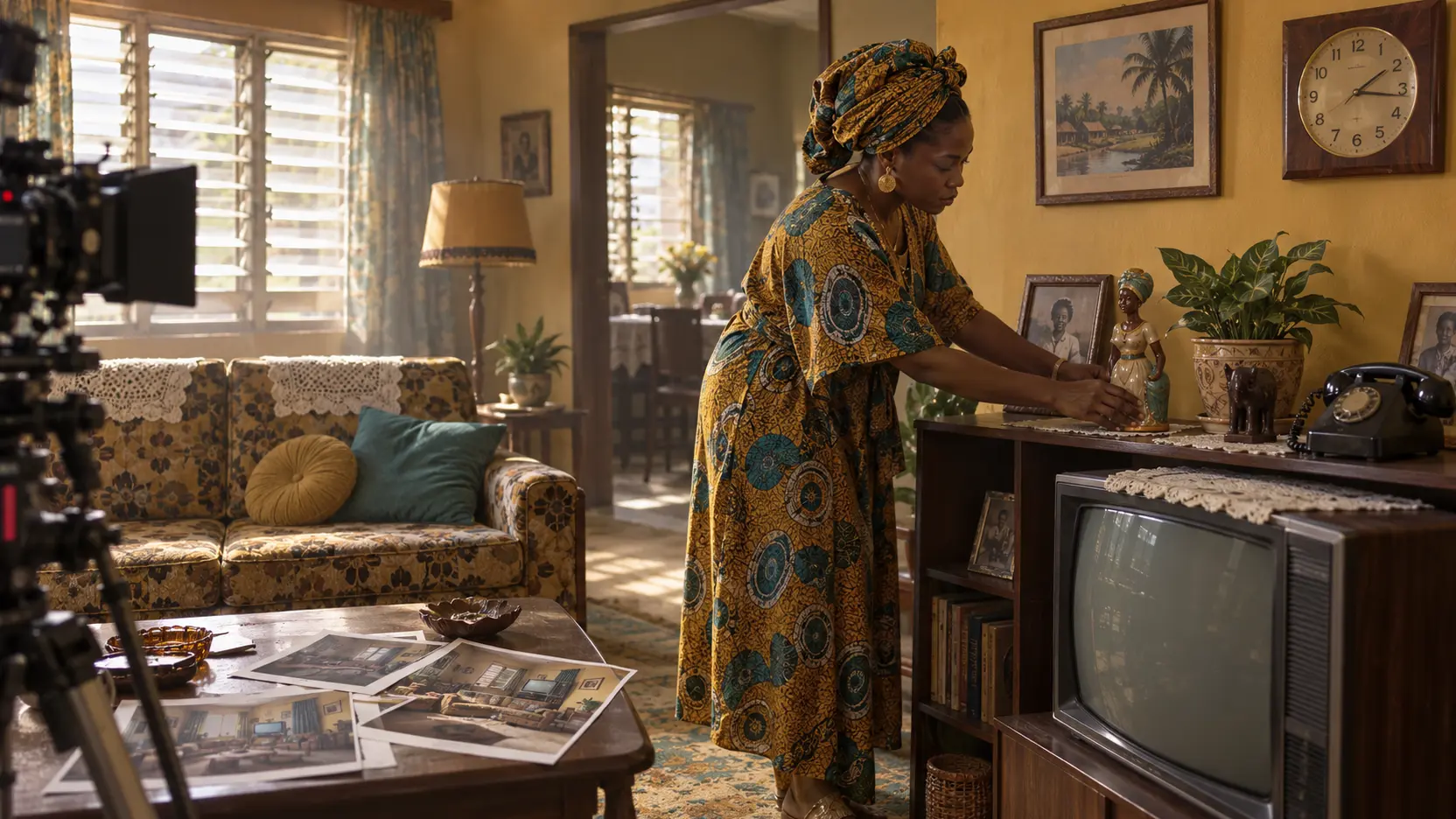
Consider an illustrative task: dressing a modest Nigerian living room for a scene set in the 1980s. A period television might establish an era, but seating arrangements, family photographs and worn surfaces could reveal more about relationships. The strongest choices work together. Filling every corner with recognisable old objects can turn a lived-in room into a display case.
Architecture shapes performance as well as atmosphere. A doorway can allow someone to overhear a conversation; a cramped passage can change how family members avoid one another. These decisions need discussion with the director and camera team. The set must support the scene’s action, leave practical working space and remain consistent with the story’s geography.
Continuity protects that world across an uneven shooting schedule. A room may be filmed over several days while the story covers only an afternoon. Records of furniture positions, prop condition and visible details allow the department to restore the scene. When continuity works, the audience can concentrate on the characters instead of noticing an unexplained change behind them.
Limited budgets make selection more important. Rather than spreading effort across too many locations, a production can identify the spaces and objects most central to the story. A carefully controlled wall, doorway and group of belongings may communicate more than an expensive room that contradicts the character’s circumstances. Restraint is effective when it follows a coherent design decision.
The work also depends on knowledge outside the film industry. Families, archivists, craftspeople, traders and local historians can help explain how objects were made and used. Keeping research notes, photographs and clear acknowledgements makes that knowledge more useful for future productions. ScreenSkills’ production-design resources provide a professional reference point, but Nigerian histories require their own situated research.
Calling the department Nollywood’s memory department is an invitation to take ordinary things seriously. A repaired chair or carefully placed photograph can carry a history that dialogue would struggle to explain naturally. Better credit, preparation and preservation of production knowledge will help filmmakers build worlds audiences recognise—and worlds they can discover with confidence.