Kunle Afolayan’s approach to filmmaking can be read through the spaces built around the work. KAP Film Village & Resort presents a physical base for production, while KAP Film & Television Academy describes a training operation. Together, these institutions offer a concrete way to discuss craft: where people learn it, where they practise it and what remains when a shoot ends.
There is a specific 2026 development. On 1 June, the academy announced a Pan-African Filmmaking Bootcamp with SOPA, the School of Performing Arts in Benin Republic. Its published plan described a 12-week programme for 20 emerging filmmakers, moving through Benin Republic, Lagos and KAP Village. These are the organisers’ announced arrangements, not independently verified completion or employment outcomes.
The significance of a permanent production environment is continuity. A location assembled for one project can disappear when the crew leaves; a maintained working site can preserve construction knowledge, useful objects and relationships with local specialists. Its value depends on how it functions between headline productions, including access, upkeep and the range of stories it can accommodate.
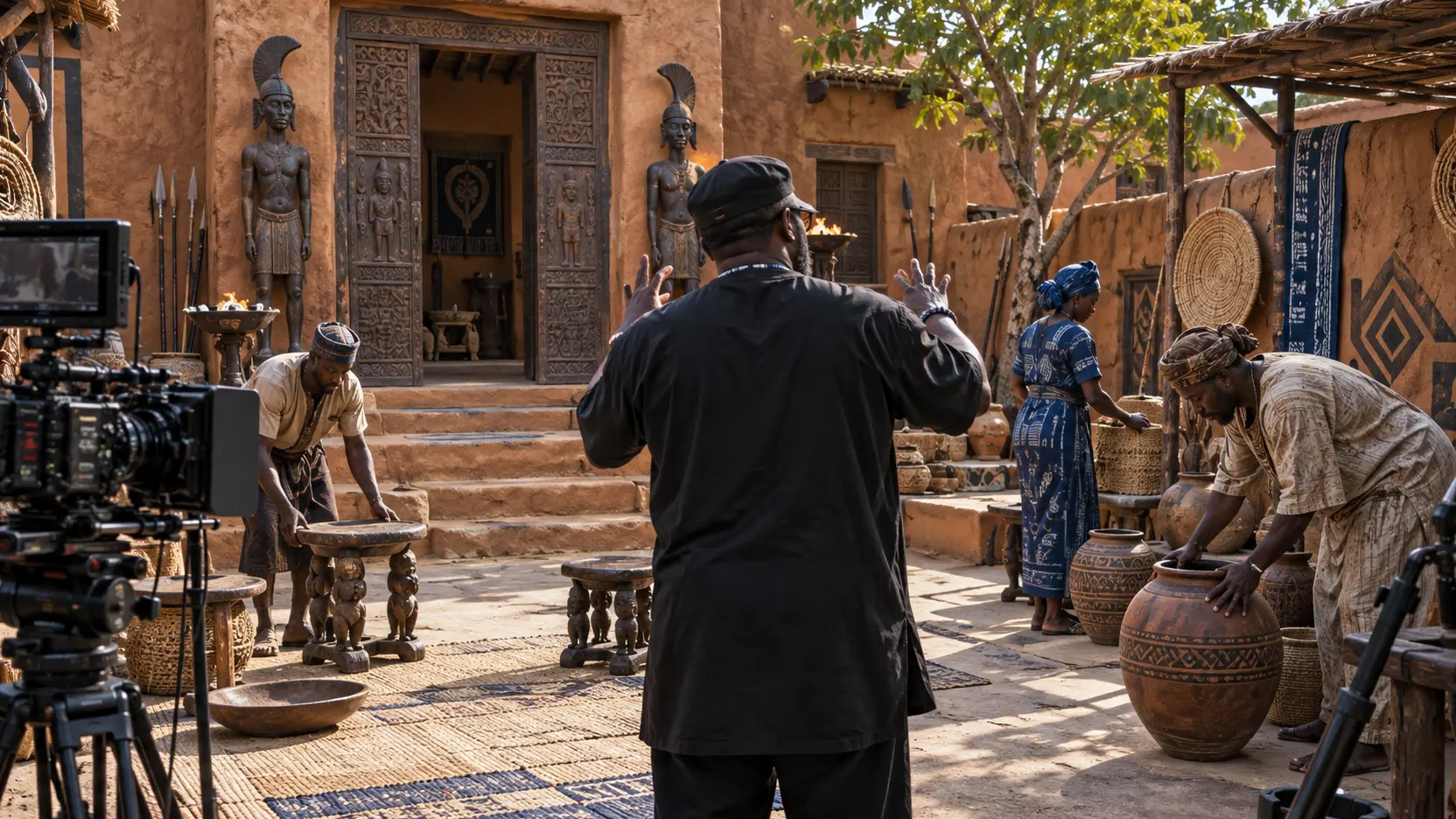
Period storytelling makes that question especially visible. A convincing courtyard is more than an earthen wall: it needs a plausible arrangement of domestic activity, entrances, tools, surfaces and personal belongings. The audience should feel that people inhabit the space when the camera is absent. Research gives those choices a foundation; collaboration turns them into a usable set.
The director is one participant in that process. Production designers, builders, painters, costume workers, cinematographers and sound teams have to reconcile their needs. A surface that photographs beautifully may create an acoustic problem; an impressive structure may restrict camera movement. Making craft visible means acknowledging how these decisions are negotiated, not treating the finished image as an individual achievement.
Training becomes valuable when students encounter those practical tensions. An exercise can ask a small team to stage the same scene with different blocking, light or set dressing, then compare the results. The point is to make choices explainable and repeatable. Access to equipment helps, but feedback, revision and responsibility for a completed piece are what turn access into learning.
The academy’s cross-border plan also raises an appealing possibility: crews learning from neighbouring production cultures while working on shared tasks. Language, working methods and available materials can differ even when the ambition is similar. A useful exchange gives participants room to contribute their own knowledge, rather than presenting one centre as the only source of expertise.
There are sensible ways to assess progress over time. Are facilities maintained? Can emerging practitioners show finished work and clear credits? Do local craftspeople receive continuing opportunities? Do alumni move into sustained practice? Those questions go beyond an opening ceremony or a training announcement and allow an institution’s impact to be evaluated without assuming it in advance.
Afolayan’s infrastructure invites Nollywood to imagine craft as something that can be taught, housed and passed on. The inspiring possibility is a cycle in which a film leaves behind more than its images: skills, reusable resources and people ready to make another world. That is how a director’s ambition can contribute to a wider culture of production.