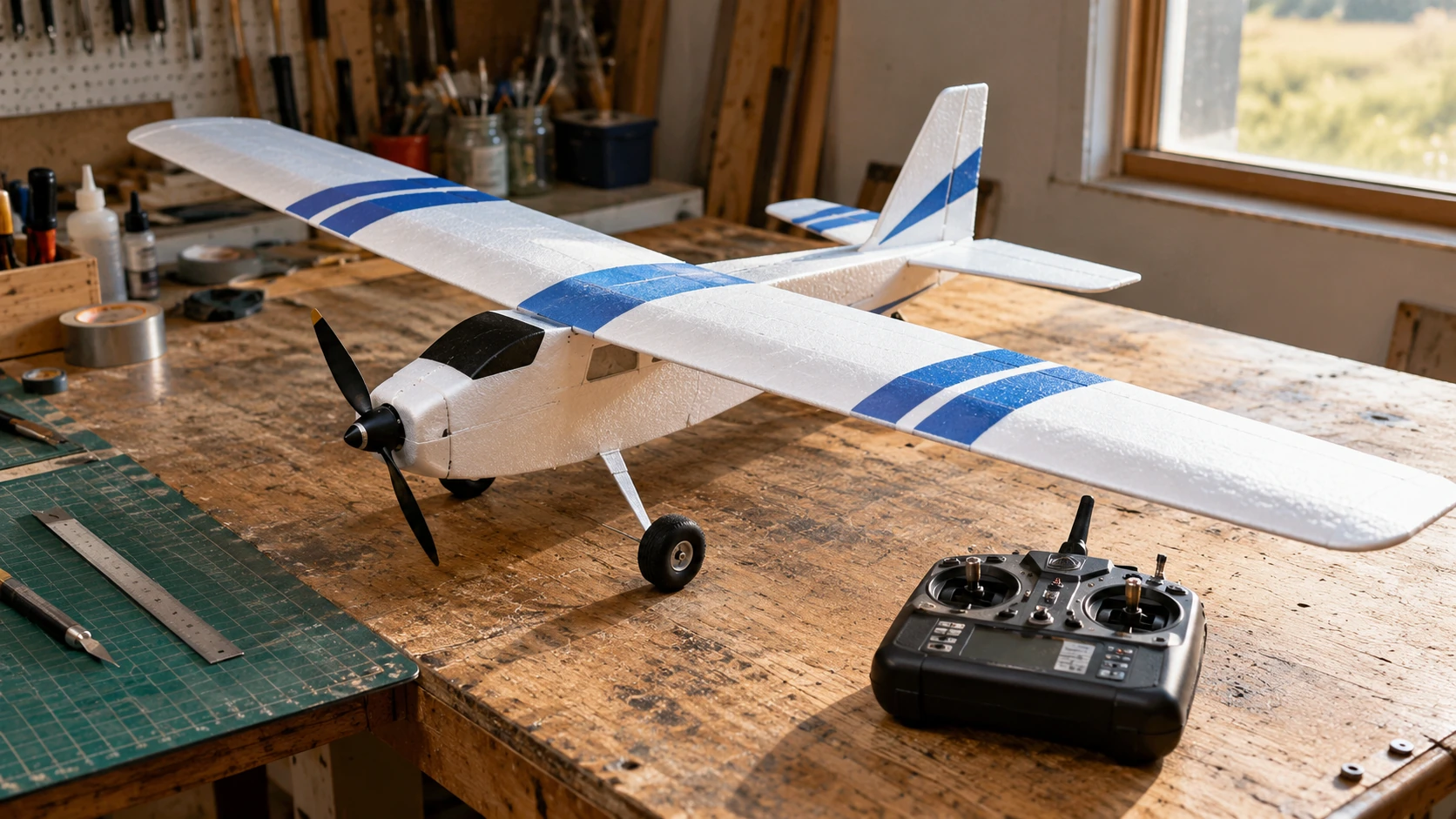
The important moment in Musa Aliyu Damilola’s story was not a photograph beside an impressive-looking aircraft. It was the point at which a model left the ground. In a January 2025 interview with Legit.ng, the Nigerian maker said he achieved a remote-controlled flight in 2017, after years of building and observing aircraft.
Aliyu identified his roots as Kwara State and his birthplace as Zaria, Kaduna State. Living near the Nigerian College of Aviation Technology gave him something an instruction manual alone could not: repeated encounters with real aircraft. He described collecting discarded cans as a child and later gaining access to a hangar through engineers he befriended.
A family move to Ilorin changed the setting. The city’s aviation college offered another connection to flight. His account distinguishes the models that flew from a larger, passenger-sized creation that attracted attention in 2019 but did not fly. That distinction makes the achievement intelligible: a working model is a serious beginning, rather than evidence of a certified passenger aircraft.
Public attention eventually connected practical making with formal education. Legit.ng reported that a 2023 demonstration helped bring a Kwara government scholarship for pilot training. Its later interview presented him as a pilot, with ambitions to manufacture unmanned aircraft. Those ambitions remain separate from proof of an established aircraft factory.
The educational lesson is particularly useful for Nigerian schools. A model-aircraft club can give pupils a reason to measure, record changes and compare results. A notebook showing why one configuration failed can be more valuable than a ceremonial unveiling. Teachers could assess the quality of observation as carefully as the final flight.
Support should also follow the work beyond its most shareable moment. Access to mentors, suitable tools, safe test locations and a small materials budget would let a promising builder repeat an experiment instead of spending months trying to replace one damaged part. A scholarship creates a different kind of opportunity from a one-off cash gift.
The economic question is which services a maker could deliver reliably. A school demonstration, a repaired model and a commercial aerial service are different products with different responsibilities. A viable enterprise needs a defined customer, a costed offer and evidence that it can fulfil the same promise repeatedly; a large audience cannot supply those things by itself.
Aliyu’s story deserves attention because it contains progression: observation, rough models, reported flight and professional training. Its most inspiring implication is practical. Institutions do not have to wait for a finished aerospace company before recognising talent; they can help a capable young person build the knowledge that makes the next step possible.