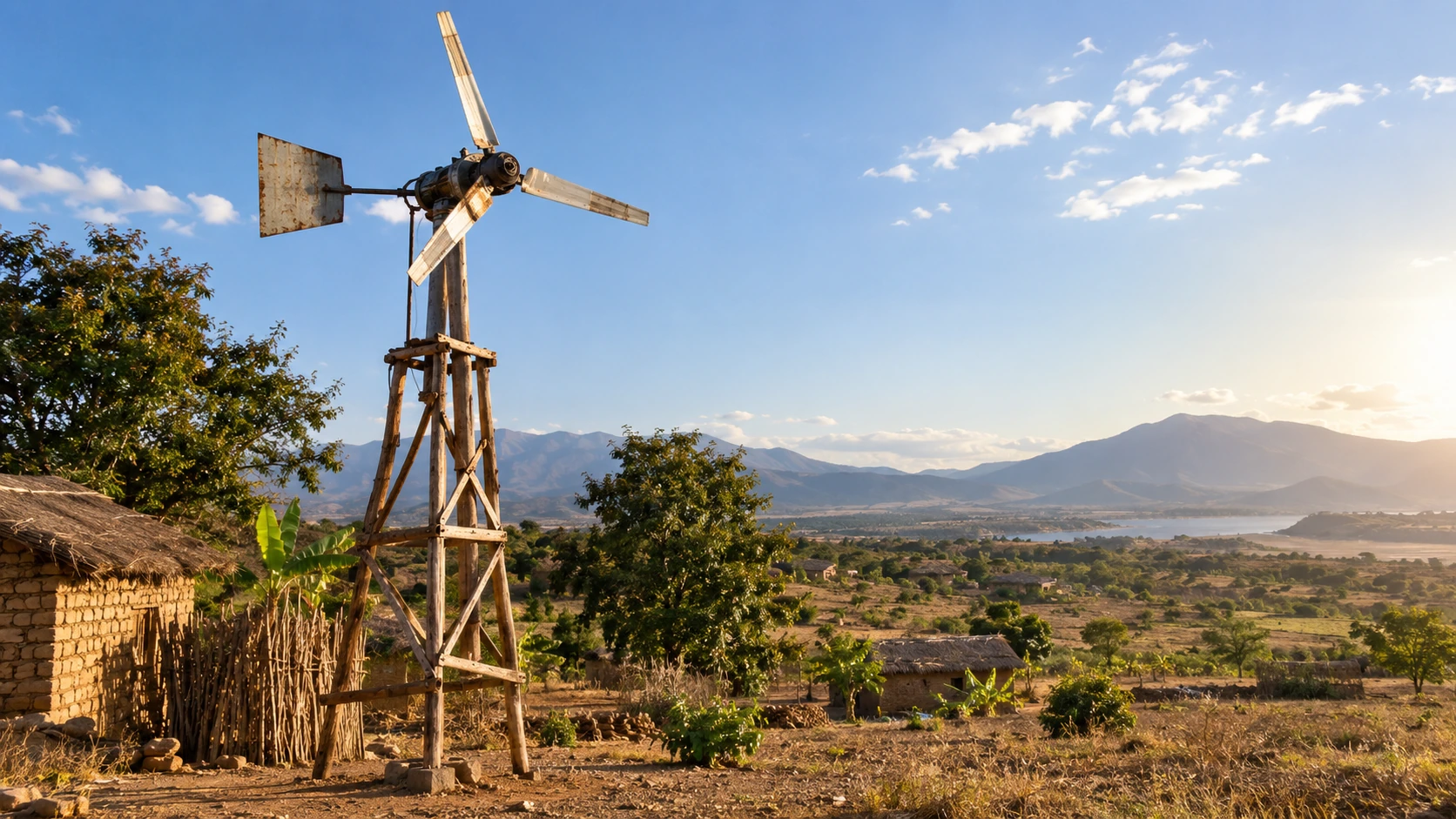
William Kamkwamba’s windmill is now associated with a bestselling memoir and a film, but the original problem was immediate: how to obtain useful electricity with very limited resources. His own biography describes a fourteen-year-old whose schooling was interrupted when famine left his family unable to pay the fees.
He continued studying with help from a village librarian. An illustration in the textbook Using Energy gave him a starting point for reasoning out an electricity-producing windmill. The resulting machine used spare parts and scrap. The story begins with access to knowledge at precisely the moment formal education had become financially inaccessible.
Contemporary reporting documented salvaged bicycle and other components, with a dynamo converting movement into electricity. The first practical gains were modest household services such as lighting and charging. This was not a village-scale power station, and its importance does not require presenting it as one.
Kamkwamba’s later biography records his Dartmouth education and work with Moving Windmills. It describes an ambition to give young Malawians tools and mentorship for practical problem-solving. Those later opportunities help explain the distance between an improvised first machine and a sustained career.
The tempting but mistaken lesson is that talented children do not need well-funded schools. Kamkwamba needed a book, a place to find it and people who took his curiosity seriously. His experience is an argument for making those resources more widely available, rather than a reason to celebrate the barriers he had to overcome.
For a youth workshop, a useful project might begin by measuring a small household or farming need. Students could document the proposed solution, the materials used and the result. Repeating a measurement after a change makes the learning visible. That process is more transferable than asking every child to reproduce a famous windmill.
An energy project must also be judged by service over time. The cost of safe construction, maintenance and replacement parts belongs beside the initial bill for scrap. Communities should compare options according to the tasks they need to power, rather than assume that the most improvised device is always the most affordable answer.
The enduring achievement is the conversion of an idea on a page into something that could be tested. Kamkwamba’s subsequent work points towards an even larger contribution: making that opportunity less exceptional. A continent full of inventive young people needs places where the next experiment can begin without depending on a miracle of recognition.