
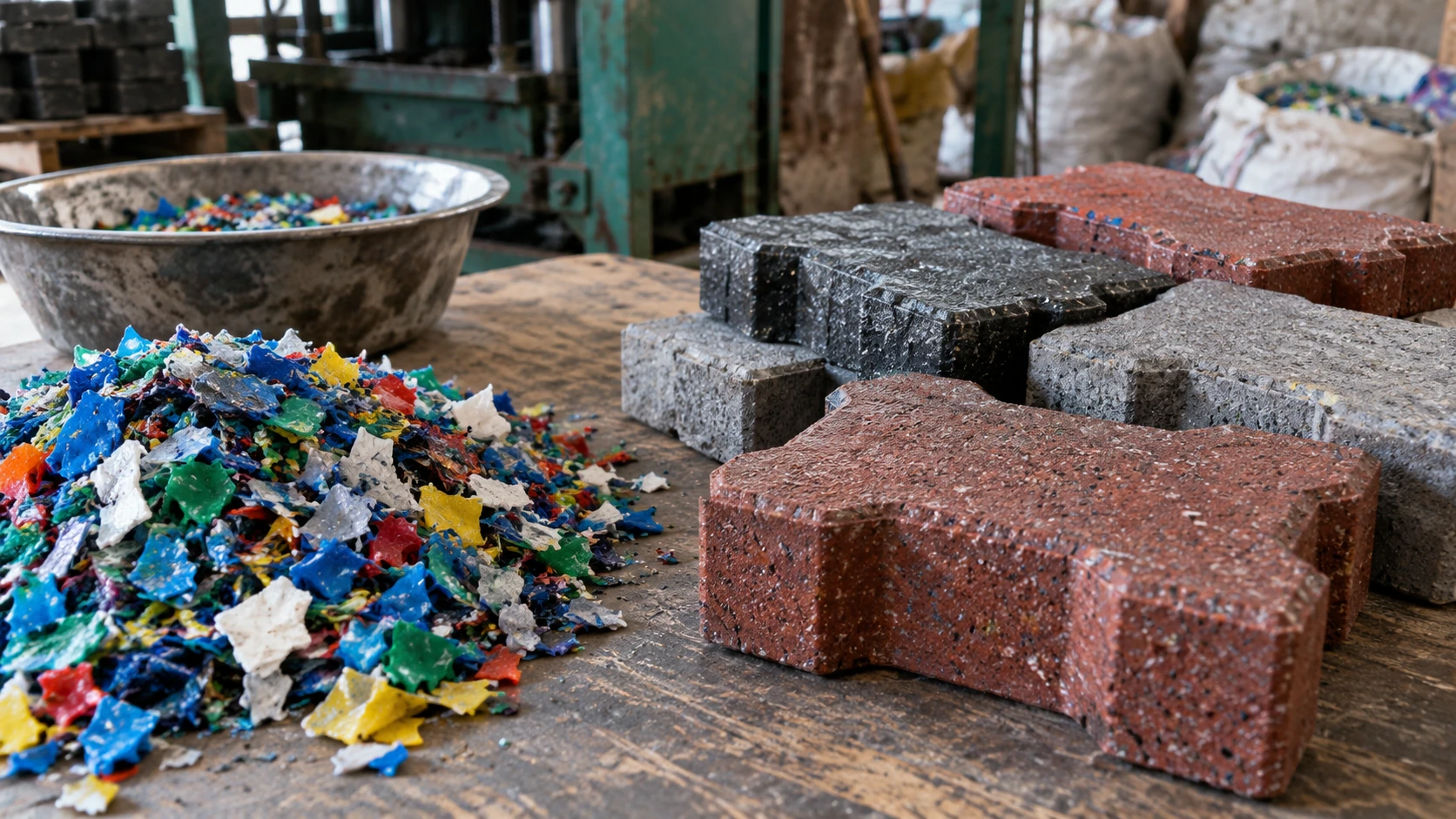
A pavement can give discarded plastic a second job. In Nairobi, Nzambi Matee developed machinery and a business around combining plastic with sand to make paving products. Gjenge Makers attracted international attention because it connected a visible waste problem with something schools and households could use.
UN Environment Programme’s December 2020 profile describes Matee beginning experiments in her mother’s backyard in 2017. It records a period of testing mixtures and refining the machinery, including access to materials laboratories during training in the United States. The finished paver emerged from development work, rather than a lucky act of melting rubbish.
The same report describes a school using the pavers on paths and a playground. That is a more concrete indication of usefulness than a stack of samples photographed in a workshop. UNEP recognised Matee as a Young Champion of the Earth in 2020; its historical production figures should not be treated as current factory output.
The product is a composite: plastic and sand perform a function together. That should not be confused with a universal method for recycling every plastic, or with permission to substitute a paving block for any structural building material. The intended application and the tested product need to remain attached to performance claims.
For a manufacturer, consistency is the demanding stage. A customer ordering a second batch expects it to fit and perform like the first. Sorting inputs, controlling production and rejecting unsuitable pieces all require work that is less photogenic than the first successful sample. That is where an inventive idea begins to become a dependable supplier.
The environmental assessment also has to follow the material beyond its first reuse. How will a worn or damaged paver be collected? Can its material be used again? What are the implications of producing and using it? These questions do not diminish recycling; they help distinguish a durable solution from simply moving waste into a different shape.
A fair business model should recognise collection and sorting as paid work. The cost of keeping inputs suitable belongs in the price of the product. For buyers, comparing installed cost and service life would be more informative than choosing a material solely because its promotional story is appealing.
Matee’s example is inspiring because it makes manufacturing visible as a sequence of decisions. A local problem led to experiments, equipment and a product with an identifiable use. The next generation of makers can learn as much from that disciplined progression as from the extraordinary sight of yesterday’s discarded plastic becoming a place to walk.