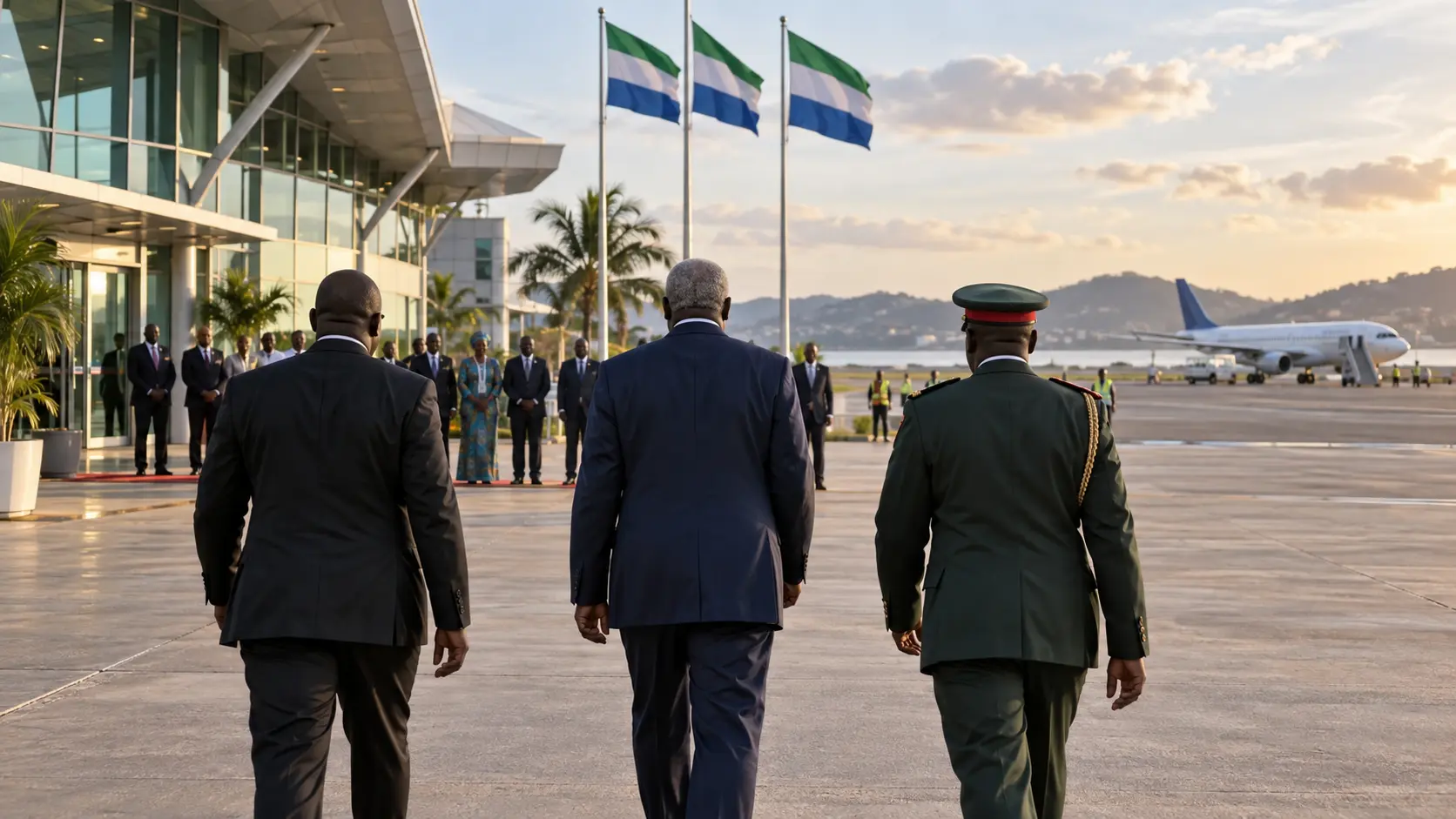
Former Sierra Leone president Ernest Bai Koroma returned home on Sunday, 6 September, after spending more than two years in Nigeria. Nigeria’s Ministry of Foreign Affairs described the journey as the conclusion of a regional diplomatic process, while reporting from Freetown confirmed that Sierra Leonean government and opposition officials received him.
Nigeria’s Foreign Affairs Minister Bianca Odumegwu-Ojukwu accompanied Koroma on President Bola Tinubu’s instruction. Former Nigerian president Olusegun Obasanjo also travelled with the delegation. Sierra Leone’s Foreign Minister Mohamed Rahman Swarray and officials of Koroma’s opposition All People’s Congress welcomed him on arrival, and Koroma told journalists that he was happy to be home.
The legal wording matters. On 14 July, Sierra Leone’s attorney-general filed a notice discontinuing the criminal proceedings under Section 45 of the Criminal Procedure Act 2024. The public notice said the case was no longer before the court, Koroma’s bail ended immediately and he was free to return after his medical treatment or at a time of his choosing.
Discontinuance is not the same thing as a trial verdict. The July notice did not say that a court had acquitted Koroma, and the justice ministry did not publicly give a reason for ending the case. Accurate reporting should therefore say that the proceedings were discontinued—not that a judge determined the allegations to be true or false.
Koroma had been charged in January 2024 with treason, misprision of treason and related offences over the armed attacks of 26 November 2023. He denied involvement. The attackers targeted military facilities, police sites and prisons in Freetown; authorities described the violence as an attempted coup, and current reporting places the death toll at 21.
Sierra Leone initially allowed the former president to travel to Nigeria for three months of medical treatment. He remained there for more than two years under an arrangement shaped by Economic Community of West African States engagement. Nigeria says sustained consultations involving ECOWAS, its government and Sierra Leonean stakeholders helped create the conditions for his return.
Koroma governed Sierra Leone from 2007 to 2018 and remains influential within the APC. His homecoming may ease one source of tension between the governing party and the opposition, but it does not settle every question arising from the 2023 attacks or the wider political divisions that followed Sierra Leone’s disputed 2023 election.
The timing also matters because Sierra Leone’s next presidential election is scheduled for 2028. Koroma has not announced a new candidacy, and his return should not be treated as proof of an electoral plan. The immediate confirmed development is narrower: he is back in the country, the prosecution against him is no longer before the court and the regional actors involved are presenting the outcome as a step toward reconciliation.
What comes next will be measured by official conduct rather than ceremony: whether political dialogue broadens, whether institutions explain unresolved legal issues clearly and whether reconciliation includes victims and other defendants affected by the 2023 violence. Those developments require separate evidence and should not be assumed from Koroma’s arrival alone.