
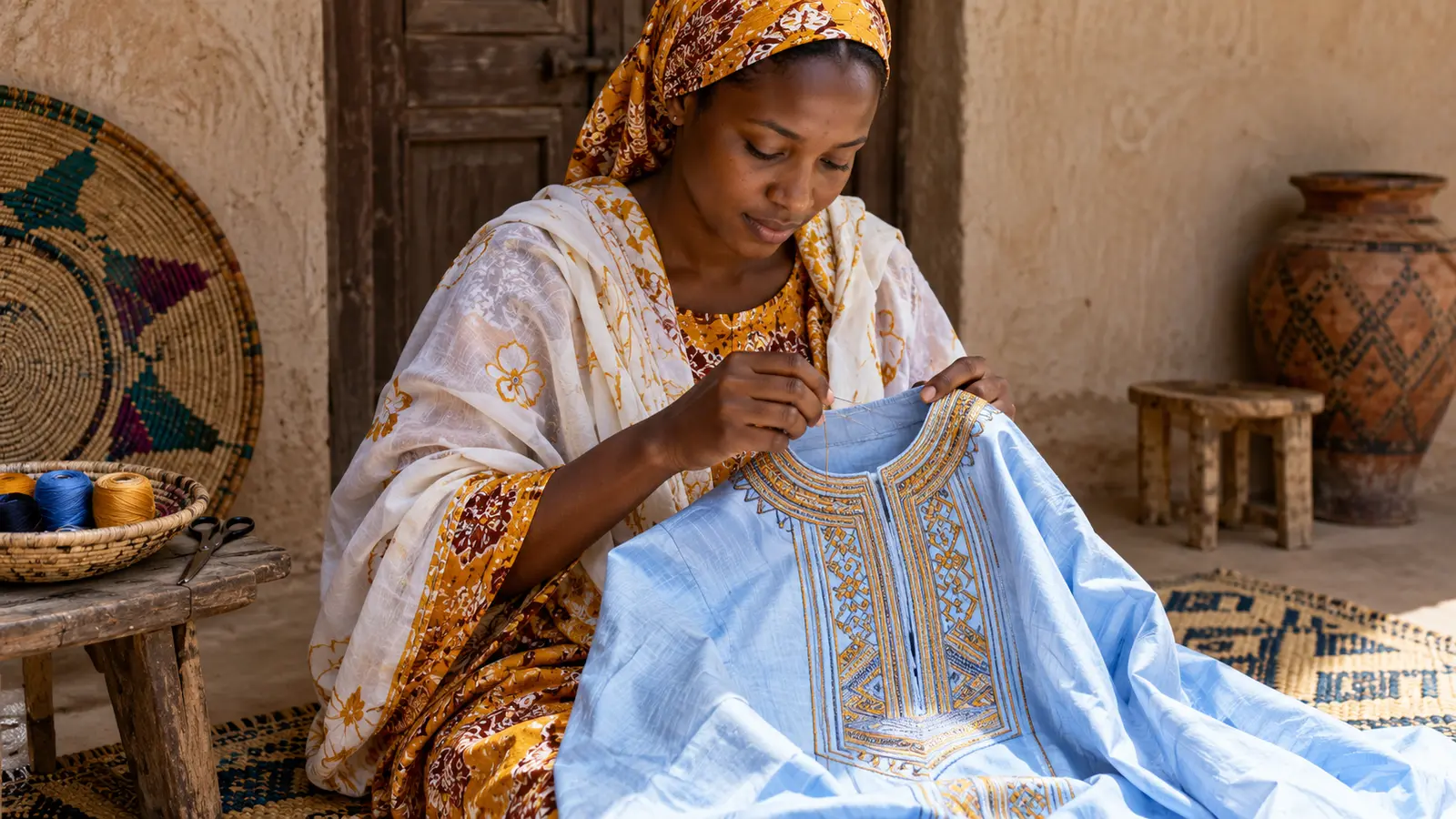
Hausa embroidery belongs to the wider textile economy of Hausaland, a cultural and commercial region centred in northern Nigeria and extending into Niger and neighbouring countries. Kano, Katsina, Zaria, Sokoto and other historic cities developed as centres of trade, Islamic scholarship, dyeing, leatherwork and tailoring. Hausa people are not defined by a single occupation: they farm millet, sorghum, maize and groundnuts; trade across markets; work in crafts, transport, public service, education and modern industry. Common foods include tuwo made from grain, soups such as miyan kuka, masa, kosai and spiced meat dishes, though diets vary by town, class and household.
The best-known embroidered men’s garment is the babban riga, a voluminous outer robe worn over a tunic and trousers. The tailor first measures and cuts the cloth, marks the neckline and chest design, and stabilises the area that will carry dense stitching. Patterns are built through counted, repeated lines rather than improvised decoration. Hand embroidery can take weeks; specialised machines now execute portions much faster. Even with a machine, the artisan must control tension, symmetry, thread density and the relationship between a heavy embroidered panel and cloth that must still drape.
The craft is connected with Hausa aesthetics, but it is not accurate to say every embroidered robe is exclusively Hausa. Fulani communities have lived for centuries within and beside Hausa-speaking societies, and the term Hausa-Fulani reflects substantial political, religious, linguistic and social interaction—especially since the nineteenth-century Sokoto Caliphate. Many Fulani people wear northern Nigerian garments and patronise the same tailors, while maintaining distinct pastoral and regional identities. Kanuri, Nupe and other northern traditions also shape the broader robe culture. Good reporting names the maker and location instead of turning a shared regional wardrobe into a rigid ethnic uniform.
Embroidery carries social information without functioning as a simple codebook. Scale, cloth quality, colour, motif, thread and the fullness of a robe may suggest wealth, office, learning, age or the gravity of an occasion. Emirs, religious leaders, politicians, grooms and family elders use formal dress to stage dignity in public, while women’s embroidered gowns, wrappers, veils and contemporary abayas support a parallel field of design and commerce. Meaning depends on the wearer, event and local convention—not on invented claims that every line has one universal translation.
Economically, one commissioned robe can connect fabric importers and local weavers, designers, cutters, hand embroiderers, machine operators, cap makers, laundry and finishing workers, retailers, photographers and event stylists. Kano’s markets and tailoring clusters serve customers across Nigeria and the diaspora. The danger is a race toward cheap, computer-generated patterns that rewards equipment owners while shrinking apprenticeships. The opportunity is to combine speed with identifiable authorship, premium hand finishing, reliable sizing and online access to clients abroad.
Modernity has therefore altered the workshop, not abolished it. Computerised machines can reproduce elaborate surfaces, social media can deliver a Kano design to London or Houston, and younger clients may request slimmer robes or embroidery on jackets and women’s wear. What must endure is the intelligence behind proportion and placement. A garment becomes heritage not because it rejects change, but because skilled people retain the power to decide how the tradition changes—and receive the income and recognition produced by their decisions.