
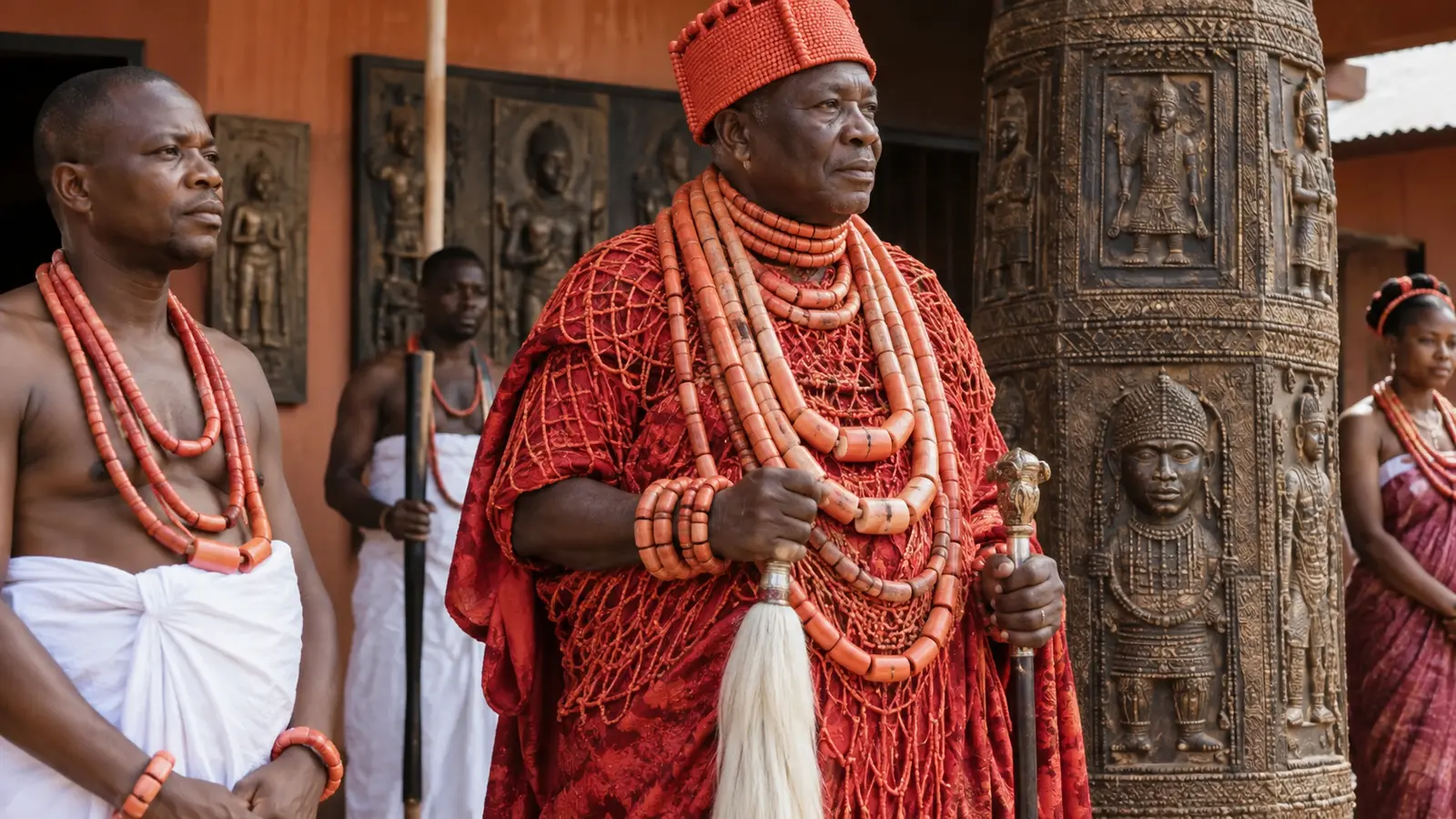
In Benin City, coral regalia is most visible around the Royal Palace and during major palace ceremonies, but the story cannot be reduced to jewellery stalls. Bead stringing, repair and regalia assembly take place in specialist workshops and trading areas within the old city, including quarters connected to the guild system for which Benin is famous. Igun Street is best known for hereditary bronze casting, while bead workers and royal-costume specialists operate through other family, palace and market networks. Precision matters: ‘Benin craft’ is not one street or one undifferentiated trade.
The beads called ivie in Edo usage are assembled into necklaces, collars, crowns, chest pieces, bracelets and anklets. The work involves sorting for colour and size, drilling or inspecting holes, threading in carefully calculated rows, constructing internal supports and repairing pieces that must carry considerable weight. Royal forms are not simply enlarged fashion accessories. Their dimensions, combinations and occasions of use are governed by court convention, title and permission.
That governance explains the role of the Oba of Benin. The Oba is not merely a celebrity wearer who advertises coral; he is the centre of an institution in which regalia makes authority visible. At events such as the Igue festival and other palace observances, coral distinguishes the monarch and titled chiefs, links the living court to ancestors and helps order the ceremonial space. Palace associations and chiefs preserve rules about presentation, while royal patronage keeps specialist knowledge in use.
Coral also has a history of long-distance exchange. Benin’s court incorporated precious imported material into a local political language, then developed ways of wearing it that became unmistakably Edo. Today the market includes inherited beads, newer coral, substitutes and manufactured materials. Because provenance, legality, conservation and price can be difficult for buyers to judge, responsible dealers should describe materials honestly and avoid implying that every red bead is ancient palace coral.
The economic chain reaches beyond the palace: importers and bead merchants supply material; artisans string and mount it; tailors coordinate garments; photographers, performers and event planners reproduce the visual language at weddings and festivals. Contemporary bridal fashion has greatly expanded demand for coral-coloured bead sets. That demand can sustain workshops, but mass-produced imports can also displace local assembly and turn a controlled symbol of rank into generic costume.
Civilisation has not erased the craft; urban life, Christianity, global fashion and digital commerce now exist beside palace tradition. The crucial distinction is between continuity and imitation. Continuity allows Edo institutions and named artisans to interpret their inheritance, train successors and earn from legitimate new markets. Imitation copies the appearance while stripping away maker, place and meaning. The Oba’s continuing ceremonial authority anchors the first; accurate labelling, provenance and fair payment are how the wider public can avoid the second.