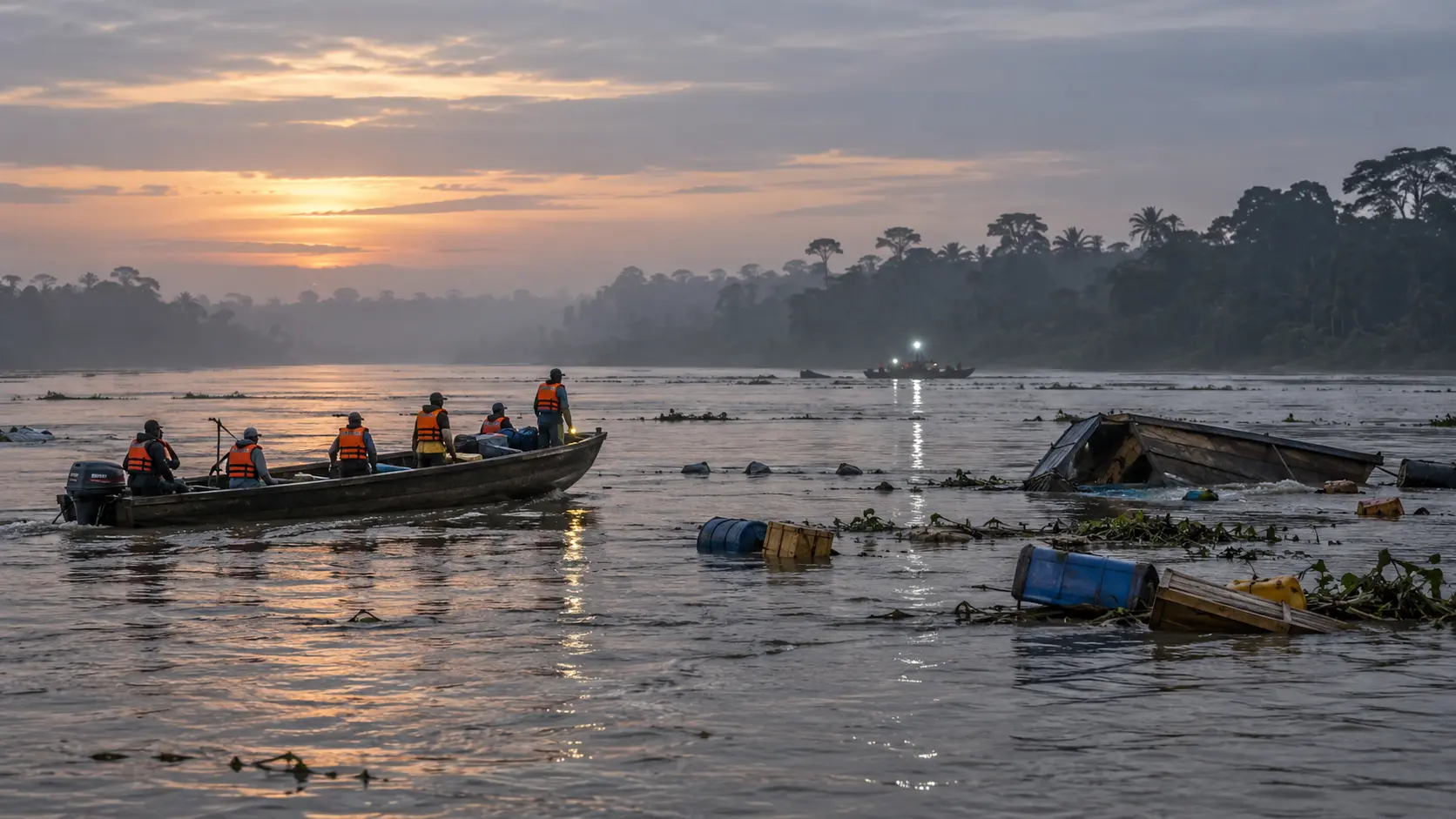
A night-time collision between two motorised boats on the Congo River has left dozens of people dead or missing near Ngombe–Lukolela in Équateur province, western Democratic Republic of Congo. The crash happened on Sunday evening, October 4, on a river route used to move people and goods between northwestern communities and Kinshasa. Search operations continued on Monday.
The Associated Press reported on October 5 that Équateur provincial interior minister Crispin Mputu said at least 30 people had died and that dozens remained missing. AP said the minister told the news agency the 30 victims had already been buried. That is the latest toll in the reporting reviewed for this article, but it should still be treated as provisional while rescue and recovery teams work.
The reported toll is not yet settled
A same-day report from the state-owned Agence Congolaise de Presse gives a materially different figure. ACP quoted the provincial minister as saying the preliminary toll was about ten deaths, several people missing and 57 survivors. It also said the capsized boat carried about 100 passengers. The timing of each statement is not clear from the published accounts, so Na Wetin Dey Happen is recording both rather than presenting either number as a final reconciled total.
The accounts agree on the core event: two vessels collided at night in the Ngombe–Lukolela area and one sank. ACP identified the boats as the metal vessel Dieu se cache, travelling from Kinshasa, and the wooden HB Super Victoire, coming from Businga in Sud-Ubangi. AP described one route as Ubangi to Kinshasa and the other as Kinshasa toward Lukolela. Those descriptions broadly place the vessels on opposing river journeys, but a full official passenger manifest and route reconstruction have not been published.
What is confirmed about the two vessels
ACP said the wooden vessel overturned and remained underwater, potentially with people still trapped inside. It reported that the 57 known survivors were receiving help through the provincial government and the Lukolela territorial administrator. AP said search teams were still trying to find victims and survivors. Neither report provides a verified final number of passengers aboard both boats.
The cause is not yet established. ACP attributed to the minister a preliminary view that night navigation and the absence of signal lights may have contributed. AP separately quoted an unnamed security officer who said one boat was overloaded with goods. That eyewitness account is an allegation from the scene, not the result of a completed marine investigation, and the direction of the allegedly overloaded boat differs between some published accounts.
Possible factors are not a completed investigation
Those uncertainties matter. A collision can involve visibility, signalling, vessel condition, loading, crew decisions, current and traffic management at the same time. Until investigators publish evidence, it would be premature to reduce the disaster to one cause—or to assume every missing person has died.
River transport is not an optional convenience for many Congolese communities. The Congo River and its tributaries connect settlements where roads are scarce, unreliable or absent. Boats carry families, traders, farm produce and supplies over long distances. That dependence makes enforcement of passenger limits, life-jacket rules, lighting, vessel inspection and night-navigation restrictions a public-safety issue with national economic consequences.
Why river travel remains indispensable—and dangerous
The latest collision follows other deadly water-transport disasters in the country. AP noted that at least 20 people died in July when a wooden boat carrying students sank in Kasai province. Recurring deaths do not make this event routine: each new disaster tests whether authorities can identify who was aboard, sustain a search, support survivors and families, and turn an investigation into enforceable safety changes.
The immediate evidence to watch is a reconciled casualty and survivor list from provincial authorities; the number of people registered or believed to have boarded each vessel; recovery of the submerged boat; and any formal finding on lighting, loading, navigation time or crew conduct. Until then, 30 is a reported provincial toll—not a final nationwide accounting—and the number missing remains imprecise. This article will be corrected or annotated when authorities publish a consolidated update.