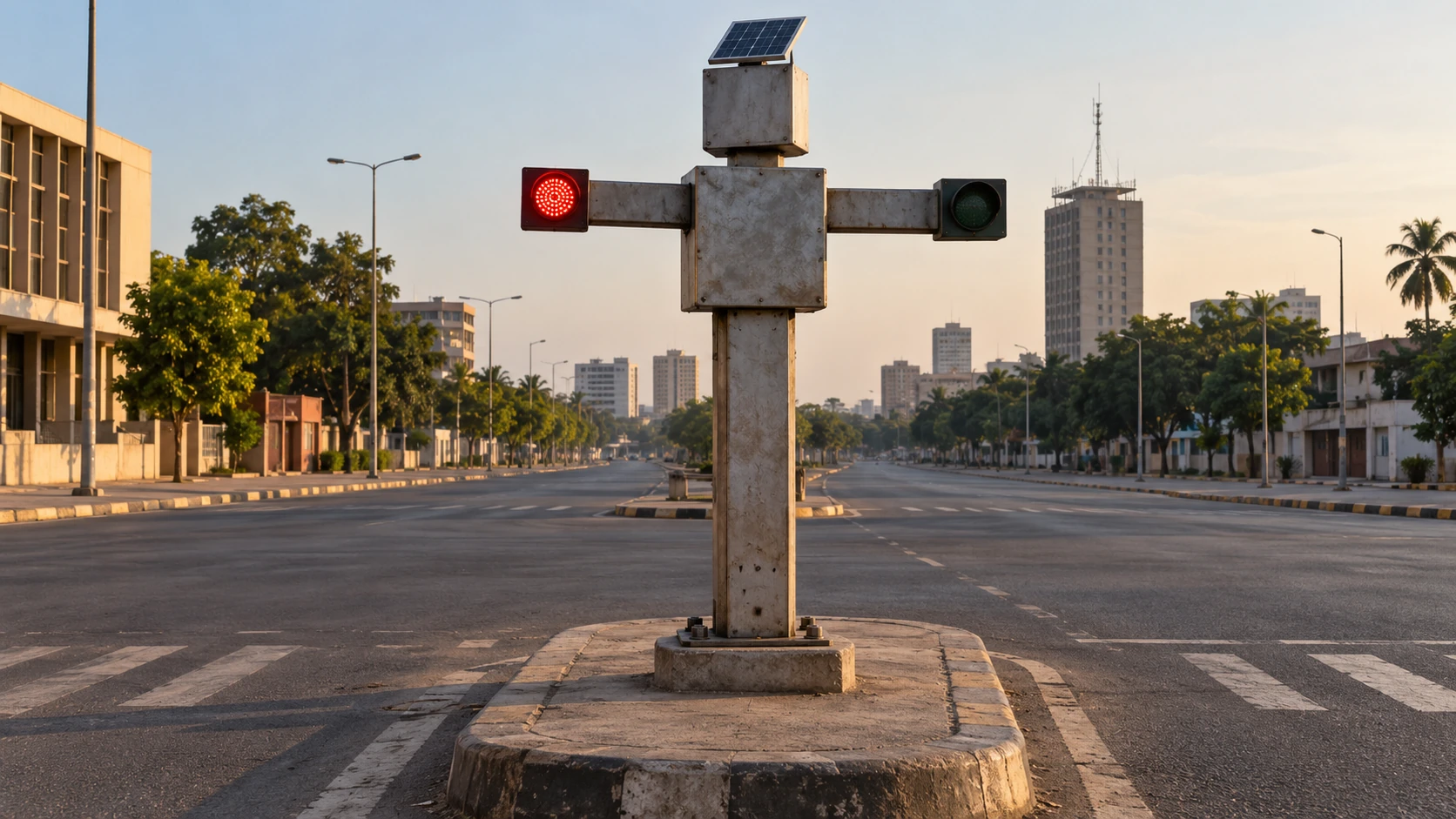
A traffic signal usually tries to blend into the street. Kinshasa’s robots did the opposite. Large metal figures appeared at junctions to direct movement, turning an everyday public-service task into a visible statement about Congolese engineering. Their unusual form made people stop and look at a system designed to make them stop and wait.
NPR’s March 2015 report, drawing on AFP coverage, described three new devices joining two that had directed traffic since 2013. It identified Women’s Technology, an association of female engineers, as the developer. The machines used solar power, rotating sections and cameras connected to the police.
Thérèse Kirongozi is identified with the project in the BYU Design Review’s March 2026 account. That account discusses her work through the lens of locally informed design. The machines are a longstanding innovation story; a newly circulated clip should not make their initial appearance seem like an event that happened this week.
The word robot can obscure what a device actually does. These installations combine signals and mechanical movement in a humanlike form. The cited reporting does not establish autonomous policing intelligence, nor does it prove that the devices can resolve the many causes of congestion on their own.
Their most interesting design proposition concerns attention. Would a driver who ignores an ordinary signal respond differently to a large, conspicuous figure? A sound assessment would examine observed compliance and collision records, while comparing the junction with other locations. Memorable street interviews are useful impressions, not a substitute for that evidence.
Public value also depends on maintenance. A city should be able to identify who services the moving parts, cleans and repairs the equipment and pays for replacement components. A locally made system offers an opportunity to develop those skills nearby, provided the operating contract supports that work.
If cameras transmit images, authorities should explain their purpose, who has access and how long recordings are retained. Road-safety technology should serve people who walk as well as those who drive. Clear crossings and understandable signals remain important even when the hardware itself becomes a tourist photograph.
Kirongozi’s robots deserve more than a novelty caption. They put women’s engineering work into a highly visible public space and invite a discussion about how a city communicates with its road users. Their lasting significance will be found in serviceable, useful infrastructure, not merely in how futuristic a junction looks.