
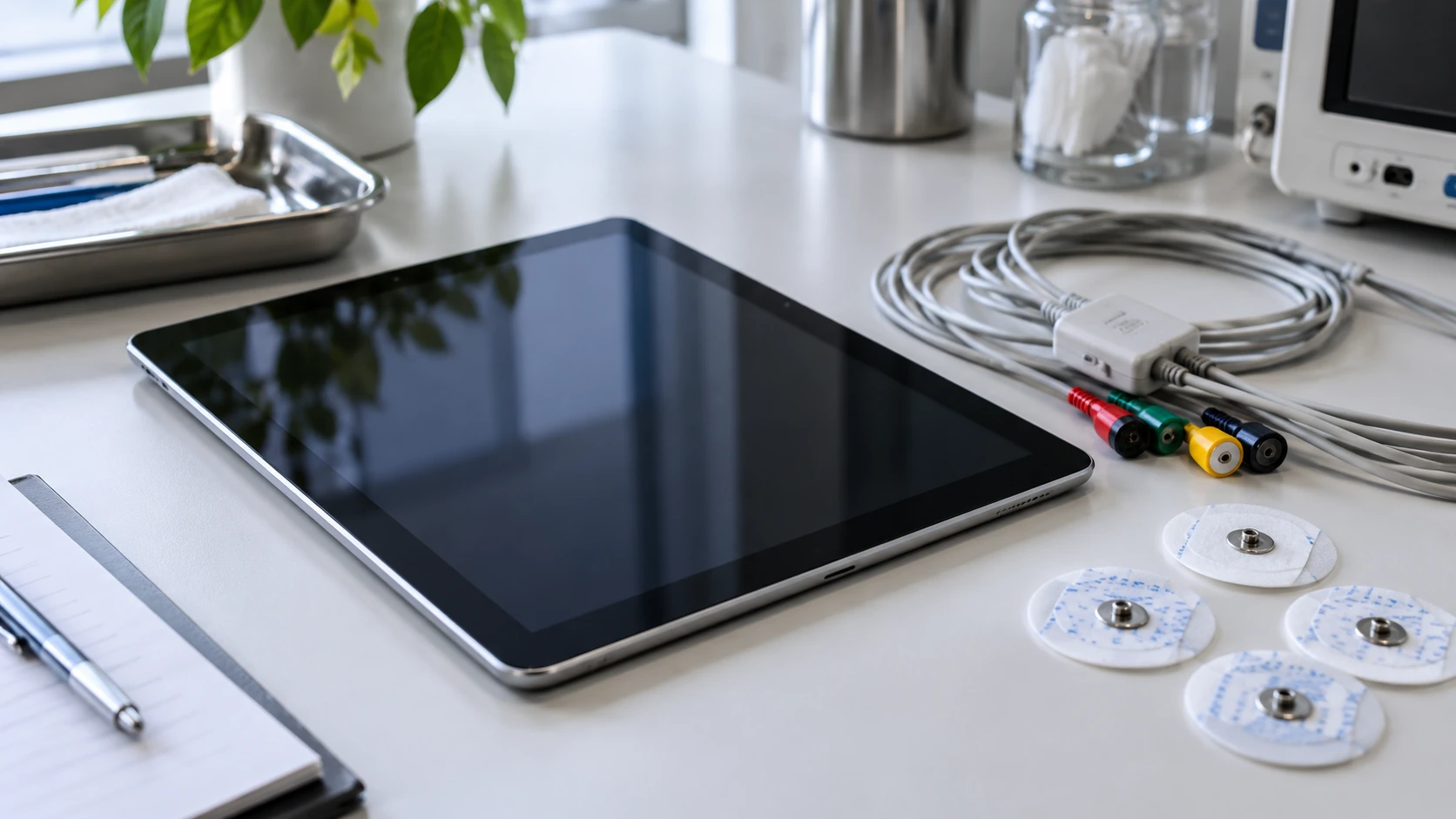
A specialist’s knowledge is of limited use to a patient who cannot reach it. Cameroonian engineer Arthur Zang’s Cardiopad addressed that gap by connecting a locally performed heart examination with remote medical interpretation. The central idea was to move clinical information across distance before requiring every patient to make the journey.
The Royal Academy of Engineering’s 2016 Africa Prize profile describes a tablet that produces a digitised electrocardiogram, or ECG. A local medical professional records the examination, and the information travels through a mobile network to a cardiologist. The specialist can return an interpretation and instructions to the attending practitioner.
The tablet therefore sits within a clinical relationship. It does not independently establish every heart condition or replace a physical assessment. Its value depends on a usable recording, an available specialist and a way for the receiving health worker to act on the response.
The Academy’s historical profile describes rapid turnaround as part of the intended service. It should not be read as a universal response-time guarantee today. A contemporary hospital considering the system would need current information about availability, servicing, clinical arrangements and the product it was actually being offered.
Distance has a financial dimension for patients. Transport, an accompanying relative and time away from work can make an examination harder to obtain. A remote pathway is attractive if it removes unnecessary travel while still arranging timely referral when travel is needed. That distinction should shape evaluation of the service.
Procurement should examine the whole pathway rather than count tablets delivered. Staff training, consumables, power, connectivity and specialist capacity belong in the same plan. A device left unused because one small component cannot be replaced represents a different outcome from a clinic that completes examinations regularly.
There is also a question of trust. Patients should understand where their information goes and who is interpreting it. Health facilities need appropriate consent, confidentiality and record-handling arrangements. These responsibilities are part of providing care through a network, not optional extras added after the hardware has arrived.
Zang’s work demonstrates a form of invention that can be easy to overlook: redesigning who can access an existing capability. The tablet attracts attention, but the more consequential ambition is a functioning connection between a community clinic and specialist knowledge. That is the achievement worth following beyond the award ceremony.