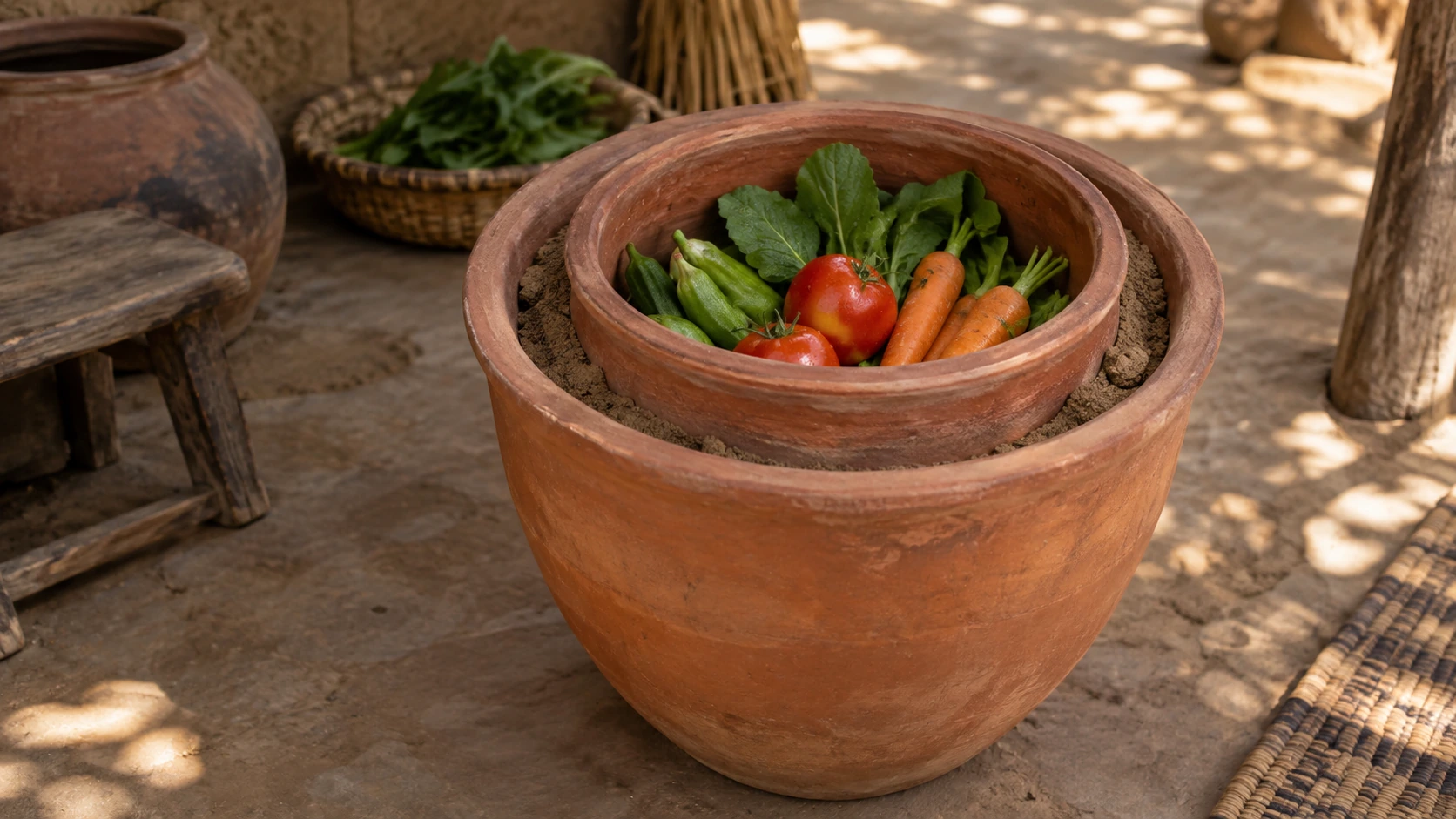
A tomato seller does not need a machine to look futuristic. She needs her stock to remain worth buying. Mohammed Bah Abba’s pot-in-pot cooler addressed that everyday pressure in northern Nigeria with an object that could sit quietly in a courtyard: one clay vessel inside another, with damp sand between them.
Historical reporting by Voice of America describes Bah Abba developing the system in the 1990s and receiving a Rolex Award in 2000. His contribution belongs within the much older family of evaporative-cooling practices. He made a familiar physical principle into a practical preservation project; he did not discover evaporation or eliminate the need for modern refrigeration.
Water evaporating from the porous outer surface carries heat away. The sand supplies moisture around the inner container, and a cover helps protect its contents. Dry air allows the process to work better than already humid air. The cooler needs suitable placement, replenished water and attention, even though it needs no electrical connection.
Research by MIT D-Lab with the World Vegetable Center and Mali’s Institut d’Economie Rurale examines both performance and use. Their work assesses vegetables through measurements such as weight loss, firmness and wilting. The project reports longer storage life for leafy greens under tested conditions, giving a more useful basis for judging the cooler than a universal promise of weeks of freshness.
Its economic advantage is time. If less produce deteriorates overnight, a trader has more scope to sell it rather than discard it. That benefit should be assessed against the price of the pots, the water required and the seller’s actual losses. A low purchase price alone does not establish whether a device pays for itself.
There is also work for local potters. A useful cooler needs vessels that fit together and survive repeated handling; consistent production is part of the technology. Training makers and customers together could create a local supply and repair relationship, instead of leaving a donated object without anyone responsible for replacing it.
The limits matter at household level. This is produce-preservation equipment, not a temperature-controlled refrigerator for meat, dairy products or medicines. A cool sensation inside a pot does not demonstrate food safety. Its strongest case is a particular one: appropriate fruits and vegetables, a suitable climate and users who can maintain it.
Bah Abba’s legacy invites a better question about innovation: how much useful service can a community obtain from materials and skills already within reach? A clay cooler will never do every job in a cold chain. It can nevertheless protect part of a harvest while creating demand for the knowledge of the people who shape the clay.