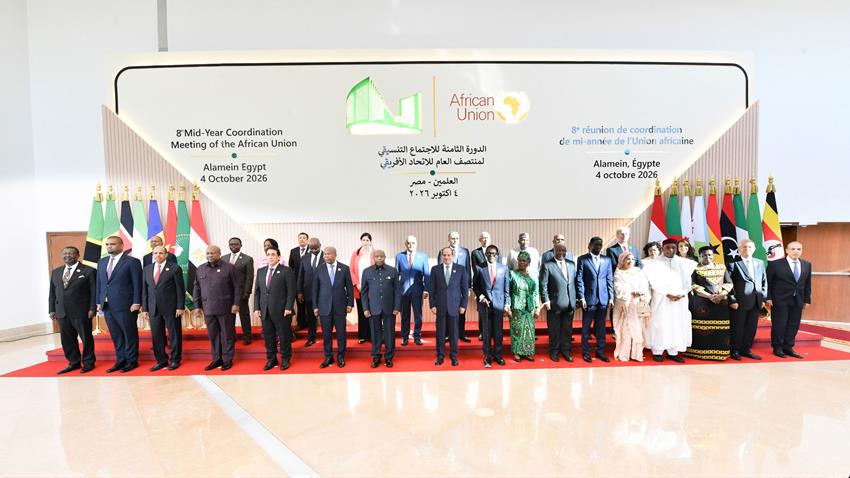
African leaders ended the African Union’s eighth Mid-Year Coordination Meeting in El-Alamein, Egypt, on Sunday, October 4, with an adopted declaration and a long delivery list for continental integration. The meeting brought together the AU, Regional Economic Communities and regional mechanisms. Its practical test will be whether those institutions convert the declaration into measurable changes at borders, in payment systems and along transport corridors.
The outcome is not one new treaty or an overnight opening of African markets. It is a set of priorities under Agenda 2063 and the African Continental Free Trade Area, alongside instructions for better coordination among institutions that often share responsibilities. The AU’s own account says the meeting reaffirmed commitments and called for action; it does not report that the remaining barriers have already been removed or that new projects have been fully funded.
Trade reforms are the clearest business test
For businesses and travellers, the most concrete part of the declaration is the call to eliminate unjustified and unnecessary non-tariff barriers, improve trade facilitation and expand cross-border payment systems. These are the frictions that can make a nominally open market slow or costly in practice: duplicate paperwork, unpredictable border procedures, incompatible systems and payments that must travel through currencies or banks outside the continent.
The declaration also backs regional value chains. That means moving beyond trading raw materials and trying to connect farmers, processors, manufacturers, logistics companies and retailers across several countries. It is an important direction, but it is not evidence that customs rules, product standards or financing are now aligned. Traders should look for country-level implementation notices and border-level changes before assuming a procedure has changed.
Manufacturing, value addition and technology transfer were placed alongside trade liberalisation. The distinction matters. Lower tariffs can expand a market, but they do not automatically create factories, reliable electricity, skilled workers or affordable capital. Governments and regional bodies will still need investment plans, procurement decisions and rules that allow smaller firms to participate rather than leaving new opportunities to the largest incumbents.
Transport, digital links and productive capacity
Infrastructure is another major strand. Leaders called for accelerated work on cross-border transport corridors, the Single African Air Transport Market and digital connectivity. Better roads, rail links, ports, air access and data networks could reduce the distance between African economies. The declaration, however, does not provide one continent-wide completion date or budget, so progress should be judged project by project.
The 2026 AU theme gave water and sanitation a central place. The meeting called for climate-resilient planning, stronger cooperation across shared river basins and more attention to women, young people, schools and vulnerable communities. Those priorities link public health to economic integration: unreliable water, flooding and drought can disrupt food production, classrooms, factories and trade corridors as directly as a customs delay.
On peace and security, the declaration emphasises preventive diplomacy, early warning and early action. Integration depends on that work because conflict can close borders, displace communities and make transport or investment impossible. The language is a commitment to improve prevention, not a claim that Africa’s current wars and security crises have been resolved.
Who is responsible—and what readers should track
A quieter but consequential decision concerns who does what. The AU Commission was asked to finalise guidelines on the division of labour between the continental body, regional communities and other mechanisms, with progress to be reported at the ninth Mid-Year Coordination Meeting. Clearer responsibility could reduce duplication, but only if the guidelines assign accountable owners, timelines and reporting standards.
Leaders also welcomed the United Nations General Assembly resolution commonly described as an effort to ‘correct the map’ by promoting fairer cartographic representation of Africa and other regions. That recognition carries symbolic and educational weight. It should not be confused with the harder economic work in the declaration: changing a map projection is different from changing a border process, payment rail or transport timetable.
The useful scoreboard now is public delivery. Readers should watch for published AU–regional division-of-labour guidelines, named trade barriers that are removed, functioning cross-border payment links, corridor contracts with financing, domestic ratifications and dated implementation reports. El-Alamein produced a serious checklist. Its credibility will come from visible results between this meeting and the next one.