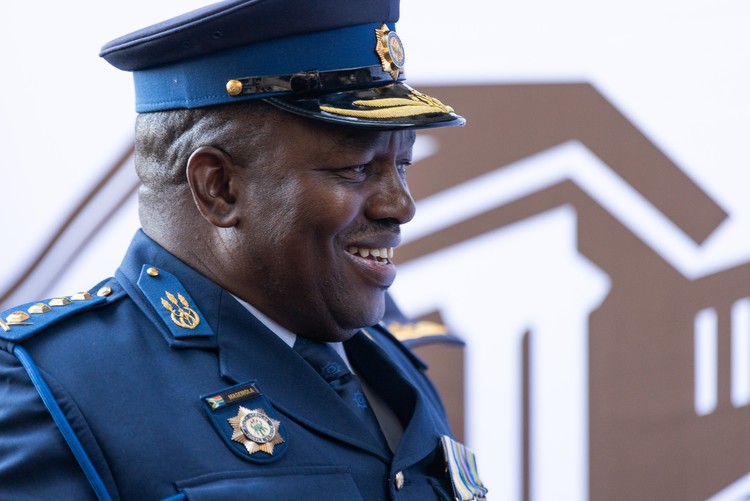
General Fannie Masemola returned to work as South Africa’s national police commissioner on Monday, October 19, 2026, moving the leadership handover from an announced timetable to a confirmed event. eNCA’s report from the Tshwane Academy says he addressed senior police leaders and put the service’s constitutional responsibilities ahead of personal interests.
Masemola presented his return as an occasion for unity and institutional renewal, rather than retaliation. Eyewitness News also reported his demand for maturity, discipline and collective responsibility among senior officers. These are statements of leadership intent: whether they change operational decisions, investigations or residents’ experience of policing remains a separate question.
Three dates behind the decision
The suspension followed Masemola’s April appearance in the Pretoria Magistrates’ Court on charges involving the Public Finance Management Act. According to the Presidency, Ramaphosa and Masemola agreed that he should be regarded as being on precautionary suspension during that period.
The announcement distinguishes two stages in the withdrawal of the case. The National Director of Public Prosecutions instructed on September 15 that charges against the commissioner be withdrawn. The Pretoria Magistrates’ Court formally withdrew them on September 22. Neither date should be confused with the October 16 decision about his suspension.
Withdrawal is the legal status described in the official statement; it is not a reported acquittal after a trial. The Presidency’s release does not set out the prosecution’s full reasoning. Describing Masemola as having been convicted, or claiming that a trial judgment cleared every allegation, would go beyond the published account.
Lieutenant-General Puleng Dimpane served as acting national commissioner during his absence. Acting Police Minister Firoz Cachalia’s separate October 16 statement thanked her for her leadership and professionalism, while welcoming Masemola’s return. The announcement therefore concerns a handover from an acting officeholder as well as the ending of a suspension.
The wider test for police leadership
Associated Press places the earlier charges in the context of an allegedly corrupt police health-and-wellbeing services contract worth about $21 million. Its October 16 report also notes the wider judicial inquiry chaired by retired judge Mbuyiseli Madlanga into alleged corruption in the criminal-justice system. Those allegations and proceedings should not be treated as findings against everyone mentioned in police reporting.
Cachalia linked the return to the ministry’s Police Reset Agenda, emphasising operational priorities, professionalism, accountability and rebuilding a capable, trusted service. That is the government’s stated programme, not evidence that the leadership decision has already improved investigations, response times or public confidence. Those outcomes require their own evidence.
The distinction matters for residents who depend on policing and for officers working under national command. A settled leadership arrangement can clarify responsibility, but the appointment decision does not by itself settle procurement disputes or the separate allegations considered in other proceedings. Accountability for institutional performance continues alongside individual legal processes.
For the police command, the immediate political test is whether the language of unity permits scrutiny as well as cooperation. Institutional loyalty cannot be measured simply by agreement with a returning leader. Our analysis is that published operational decisions and accountable handling of complaints will offer stronger evidence of renewal than the tone of a first-day address.
What changed in this report
Publication history: this article was first published on October 17 after the Presidency announced that duties would resume on October 19. It was materially updated on October 19 after current reporting confirmed the return and the address to senior officers. The original publication date and URL are retained; the archival photograph is unchanged.