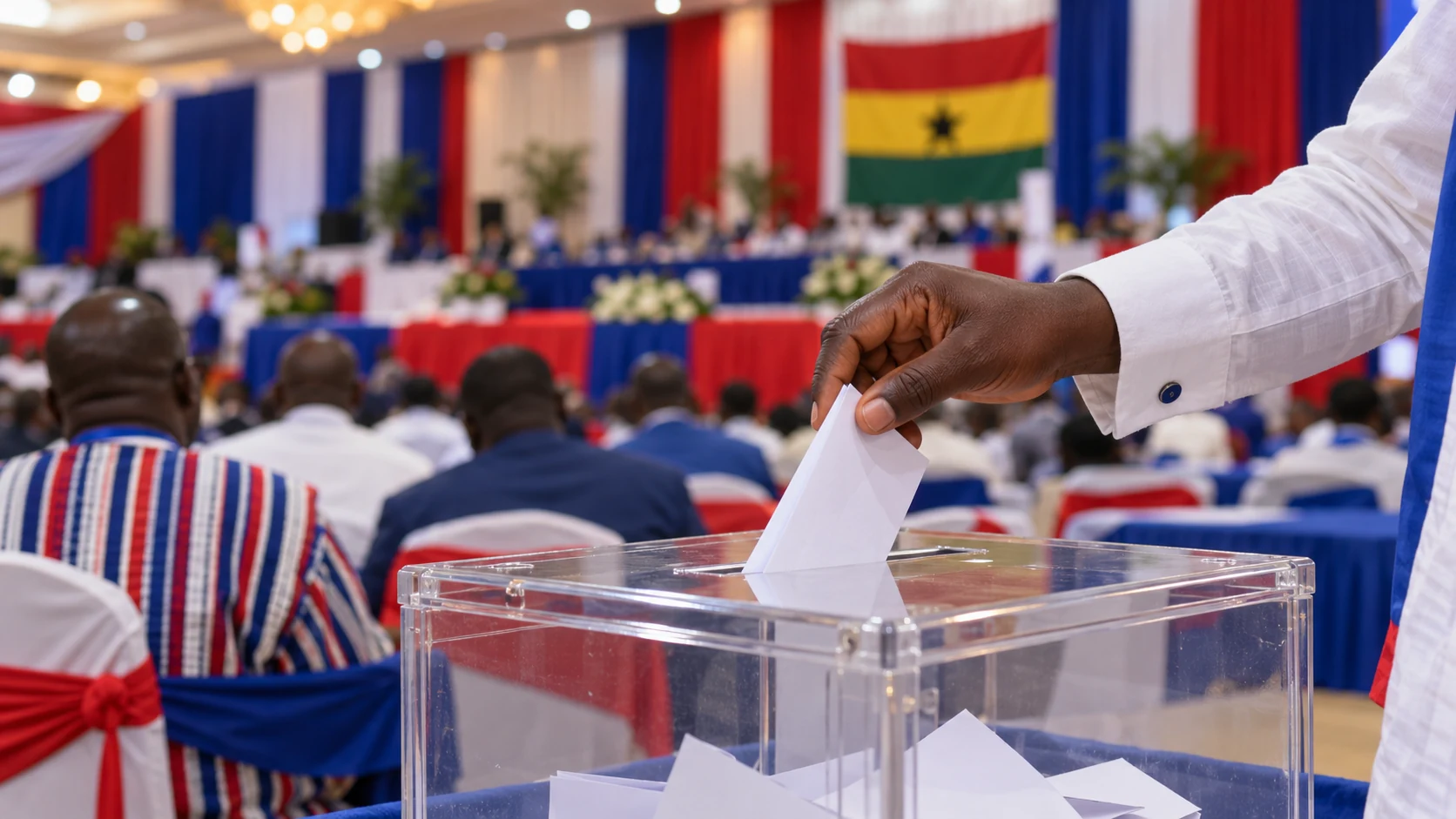
Ghana’s opposition New Patriotic Party has elected former General Secretary John Boadu as National Chairman, completing a national leadership contest held at Baba Yara Sports Stadium in Kumasi on Saturday, October 3. The Electoral Commission supervised voting and counting, and the results were announced after polls closed. This was an internal party election, not a national vote or a change of government.
GBC Ghana’s published sequence of the Electoral Commission’s declaration gave Boadu 2,888 votes. Former Energy Minister Boakye Kyerematen Agyarko placed second with 2,408, former chairman Paul Afoko received 790 and Sammy Crabbe polled 41. Boadu succeeds Stephen Ayesu Ntim, who did not seek another term, and is expected to serve for four years as the party reorganises in opposition.
A clear win, but not an unchecked mandate
The result is a political return for a figure who has occupied several positions in the NPP’s national machinery. Boadu previously served as General Secretary and has worked in organising, communications, finance and youth structures. Experience was central to his chairmanship campaign, but the vote also reveals a substantial bloc behind Agyarko; rebuilding the party will require more than treating the result as a winner-takes-all endorsement.
The chairman’s immediate task is organisational rather than governmental. He must help reconcile rival camps, strengthen constituency operations and coordinate fundraising and election preparation. He does not acquire public office through this vote, and the NPP’s internal decisions do not bind Ghana’s government, Parliament or Electoral Commission.
Kodua stays as the party’s operational anchor
Justin Kodua Frimpong retained the General Secretary position with 4,486 votes, according to GBC Ghana’s results report. The wider executive team includes Daniel Nii Kwartei Titus Glover as National Organiser, Mavis Hawa Koomson as National Women’s Organiser, Abanga Fuseini Yakubu as National Youth Organiser, Alfred Kwajo Thompson as National Treasurer and Mohammed Ali Suraj as National Nasara Coordinator.
That combination places Boadu and Kodua—rivals in the 2022 General Secretary contest—inside the same leadership team. Their working relationship will be watched closely because the General Secretary manages important administrative and organisational functions while the Chairman provides political coordination. Reports of unity will matter less than evidence that the two offices can make decisions, settle disputes and communicate consistently.
Delegates also changed who leads the NPP
Delegates also approved 14 constitutional amendment motions. The most consequential change makes the party’s elected presidential candidate its leader whenever a flagbearer has been chosen. When the NPP is in government, the sitting President remains party leader until a new presidential candidate is elected. The change reverses a clause adopted in January that had placed the National Chairman at the top at all material times.
The constitutional process produced confusing early coverage. An initial report said consideration would be postponed because of time pressure, but later accounts from multiple Ghanaian newsrooms said delegates proceeded and approved all 14 motions. The final reported position is therefore approval, not postponement. Other changes affect vice-chairperson elections and appointments, communications posts and the party’s information-technology role.
Why the reset matters before 2028
The practical effect is to give the NPP’s presidential candidate, Mahamudu Bawumia, formal political primacy while Boadu runs the national party structure. That division can clarify authority, but it can also create friction if campaign strategy, appointments or resources are contested. The arrangement will be judged by whether roles remain clear and internal disagreements are resolved without paralysing the opposition’s work.
For Ghana’s democracy, a functioning opposition should scrutinise government, offer credible policy alternatives and organise lawfully between elections. The NPP’s new executives have now been chosen, but no national electoral outcome follows automatically. The meaningful milestones will be transparent implementation of the amended rules, reconciliation after a competitive contest, constructive opposition and a coherent programme that voters can assess before 2028.