South Africa’s Western Cape government says emergency water deliveries are continuing in Beaufort West while engineers work on infrastructure damaged by severe flooding. The provincial update issued on Wednesday, 9 September, confirms that the town has not yet returned to normal water service.
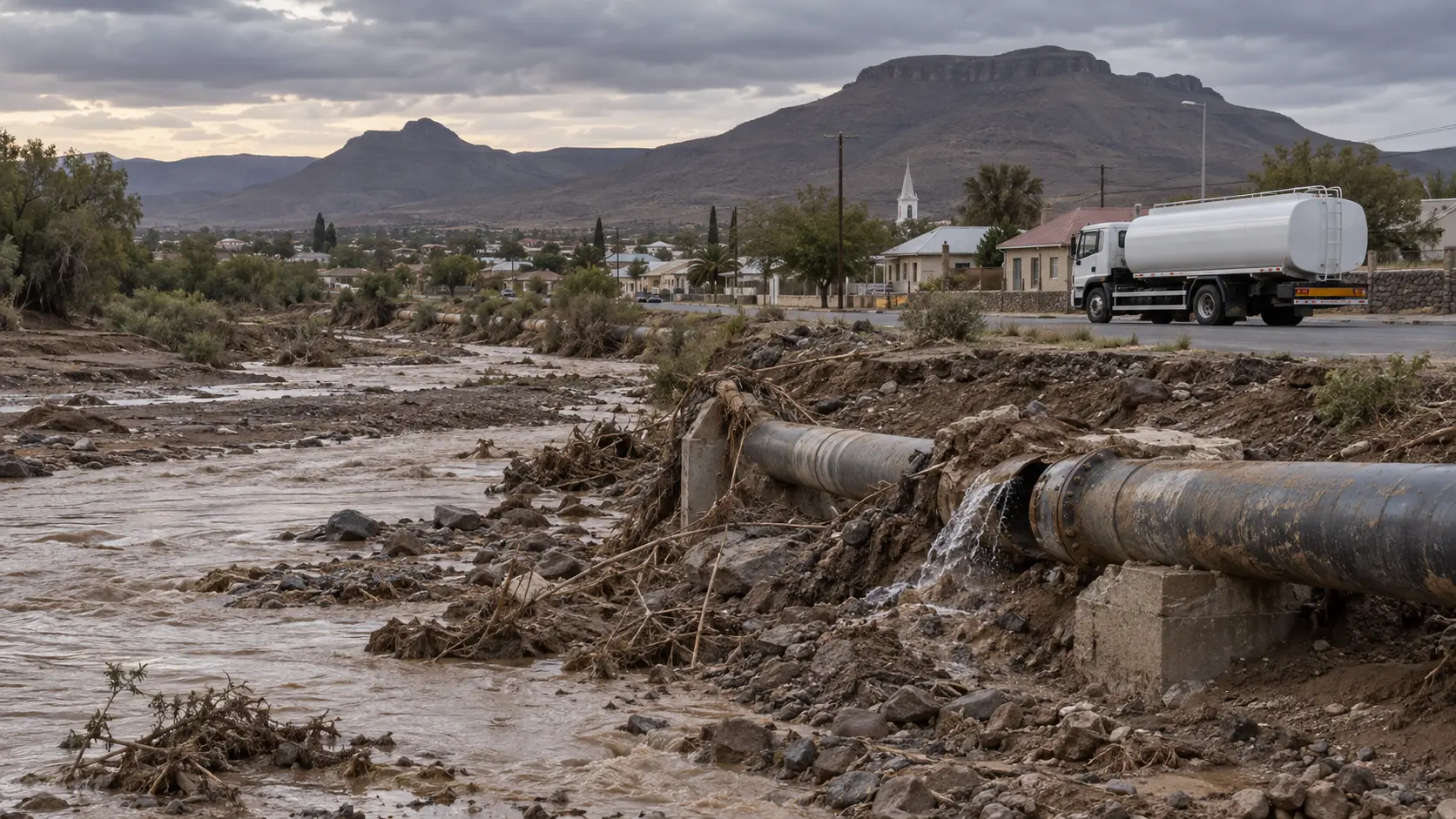
Officials say the incident was identified on 4 September after flood conditions damaged critical supply infrastructure, including the town’s 600-millimetre main pipeline. High river levels initially prevented a full inspection, although technical teams have continued working and parts of the municipal system have been restored.
The response now brings together Beaufort West Municipality, the Central Karoo District Municipality, the Provincial Disaster Management Centre, provincial departments, private companies and humanitarian partners. A Joint Operations Centre is coordinating water tankers, distribution points, engineering support and specialised repair materials.
The Western Cape government has made R1 million available for emergency repair work. That allocation supports immediate intervention; it is not presented as a final estimate of the damage or a complete reconstruction budget. Officials have not published a firm date for full restoration of the main system.
Authorities also stress that an emergency response does not depend on a formal disaster declaration. Provincial Local Government MEC Anton Bredell said classification is a separate legal process and that repair and relief work was already under way. Beaufort West is therefore experiencing an active municipal emergency, but the provincial statement does not announce a formal disaster classification.
The disruption reached schools during term examinations. Primary schools closed while secondary pupils attended only for scheduled assessments, according to local reporting on the education department’s arrangements. The Western Cape Education Department now says all schools are expected to reopen on Thursday, 10 September.
Reopening schools is a sign that contingency planning has advanced, not proof that household taps across the town are safe or reliable again. Schools need sufficient drinking water and sanitation to operate, while residents, clinics, older people and businesses remain dependent on coordinated supply until the municipality confirms normal service.
A second setback complicated interim relief on 8 September, when the municipality said a private contractor damaged the smaller Brandwacht pipeline after it had been repaired. SABC reported that the municipality opened a case over the damage. That allegation and any resulting liability still require investigation; it should not be treated as a completed finding against the contractor.
Beaufort West entered the flood crisis with longstanding water stress. A provincial assessment in February said the municipality was relying heavily on boreholes, faced very high unaccounted-for water losses and was preparing tighter restrictions. The current failure was triggered by flooding rather than drought, but the older weaknesses reduce the margin for absorbing infrastructure shocks.
The next reliable milestones are access to and repair of the main pipeline, reservoir recovery, water-quality confirmation, normalised tap supply and safe reopening of every school. Until those are documented, tankers and authorised distribution remain essential—and official statements about progress should not be mistaken for completion.