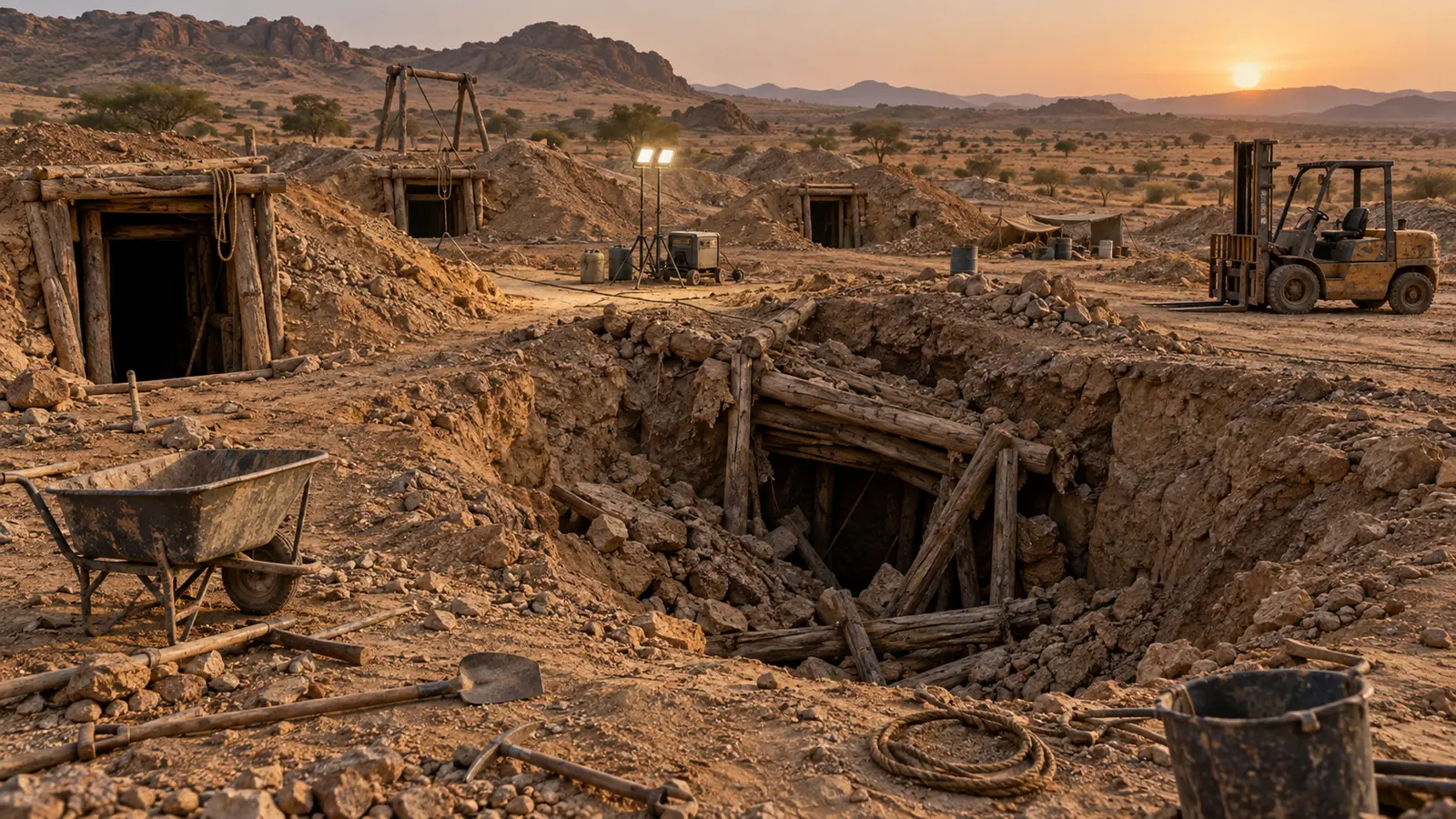

At least 10 people have died and 21 have been injured after artisanal mining shafts collapsed in Sudan on Saturday, 19 September 2026. Reporting published on Sunday places the accident at Ouni in Red Sea state, in the country’s northeast. AFP, using the spelling Awny, separately obtained the same casualty figures from survivors and described the area as near the Egyptian border.
Darfur24 interviewed witnesses and relatives who said five shafts had collapsed northeast of Al-Ansari market. Workers came from Darfur, Kassala and Red Sea state. Its account and AFP’s interviews agree that people remained beneath the debris on Sunday; neither establishes a final number missing. The reported death toll is therefore a minimum, not a completed accounting of everyone inside.
A search with no final missing-person count
Ultra Sudan cited a statement from the Dar Hamar Emergency Room reporting the recovery of 10 dead and 21 injured people. The local response group appealed to people in Ouni and neighbouring areas to contact relatives and the group so their safety could be checked. The report said some injured miners had been taken to Port Sudan, but did not give a verified breakdown of their medical conditions.
The available accounts describe a difficult rescue with limited resources. An AFP interviewee said miners were organising the search themselves with little equipment. Darfur24 witness Al-Nazir Abdullah Ibrahim described earthmoving work continuing on Sunday morning because the collapsed shafts had prevented recovery of everyone. These accounts do not establish the full equipment inventory or the number of professional rescuers at the site.
Families waiting far from the mine
The loss reaches beyond the mining area. Darfur24 reported that several victims came from Gereida and Al-Joghana in South Darfur, around 90 kilometres south of Nyala, and that mourners had gathered in Gereida. For families far from the shafts, identifying those recovered and locating missing relatives are immediate concerns. This report is not publishing a purported complete casualty list because none is established by the sources reviewed.
No verified technical explanation for this collapse appears in the reporting cited here. The number of shafts and accounts of buried workers do not, on their own, establish whether geology, excavation practices or another factor triggered the failure. Nor do they establish legal responsibility. A credible investigation would need to distinguish the initial cause from any shortcomings in worker protection or emergency response.
Separate disasters, a shared safety problem
This is not an updated toll from the earlier al-Zara disaster near Al-Nuhud in West Kordofan. On 16 September, Associated Press reported 82 bodies recovered there, citing local officials and an emergency responder. The sites, dates and casualty counts must remain separate. Republishing that older disaster under a new date would obscure the fact that Sudan has now suffered another fatal collapse.
Informal mining supports households where other livelihoods are scarce, while poorly protected shafts expose workers to repeated danger. Sudan’s war has intensified the pressures on civilian life and public services, but the evidence reviewed does not link this particular collapse to an attack. The next decisive information will be a reconciled list of survivors and missing workers, a final rescue account and an independently supported explanation of how the shafts failed.