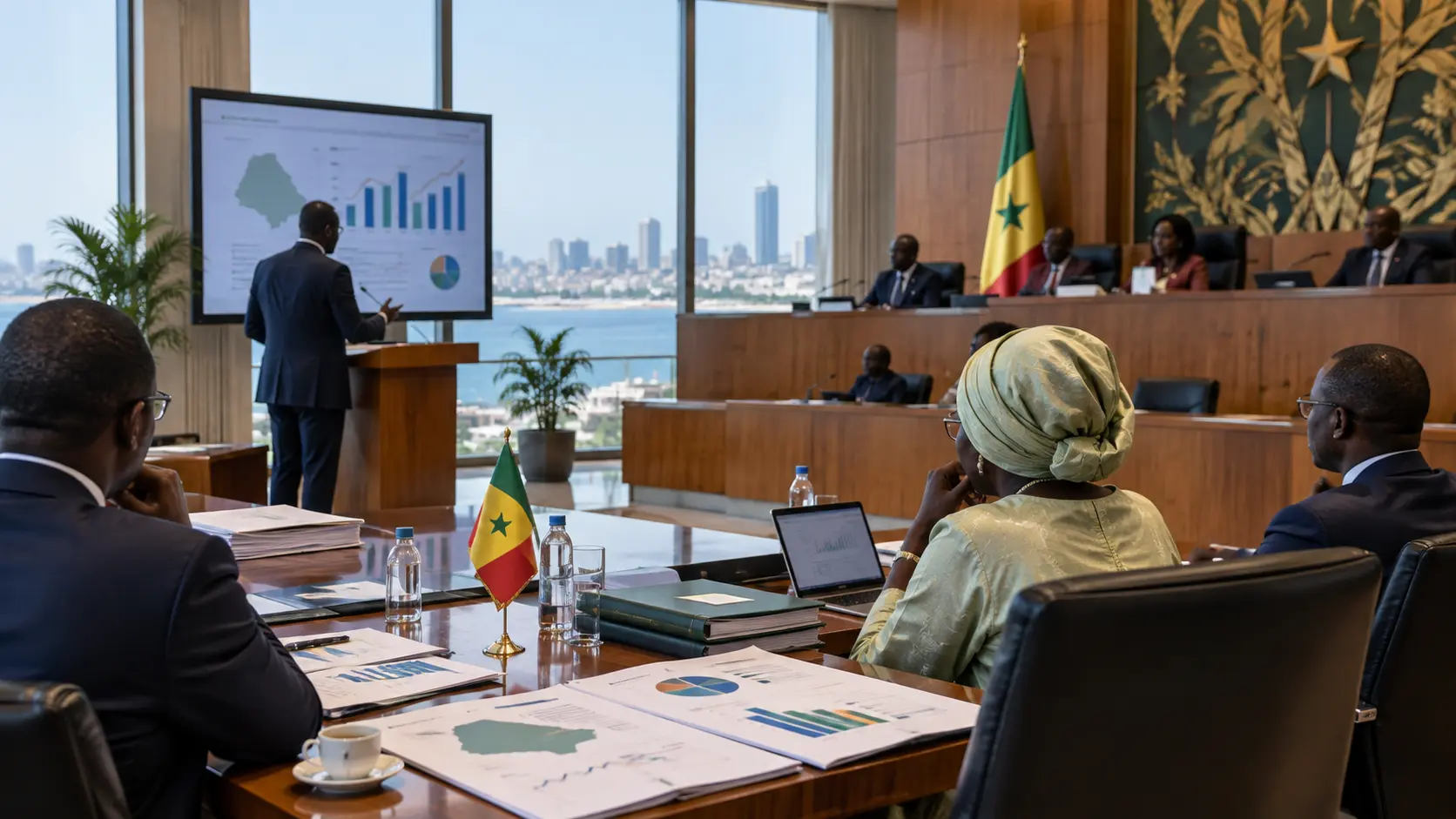
Senegal’s Prime Minister Ahmadou Al Aminou Lo defended the country’s proposed $2.2 billion programme with the International Monetary Fund during his general policy declaration before the National Assembly in Dakar on Tuesday, 8 September. The address was an important political test for a government trying to repair public finances while facing criticism that closer IMF involvement conflicts with earlier promises of economic sovereignty.
The most important qualification is that Senegal does not yet have a fully approved IMF loan. IMF staff and Senegalese authorities reached a staff-level agreement on 1 September for a proposed 36-month Extended Credit Facility arrangement worth about $2.2 billion, or 1.537 billion Special Drawing Rights. The IMF says the arrangement remains subject to approval by its management and Executive Board.
Approval also depends on more than a routine vote. The IMF says Senegal must take decisive corrective measures connected to its request for a waiver over earlier misreporting of public-finance data and must secure the necessary financing assurances from partners. Those conditions mean the amount, duration and policy framework are agreed in principle, but the money should not be described as disbursed or guaranteed.
Lo told lawmakers that Senegal’s finances made an IMF programme necessary and argued that the government had not surrendered the national interest. He said the new framework would focus on investment and transparency and rejected the prospect of the kind of indiscriminate austerity associated with structural-adjustment programmes of past decades. Those are the prime minister’s assurances; the final programme documents and budget measures will show how they are implemented.
Resistance emerged inside the chamber, including from Guy Marius Sagna, a lawmaker associated with the Pastef majority. Africanews reported that Sagna accused the government of placing Senegal under IMF control. The dispute matters because the government will need political support to translate an external financing framework into revenue measures, spending decisions and debt-management reforms that affect households and businesses.
The policy statement placed the agreement inside five broader commitments: restoring the public accounts; putting the state and rule of law in order; strengthening national sovereignty; improving daily living conditions; and directing public policy toward greater territorial equity. The government also promised tighter selection of high-impact projects, stronger oversight of public contracts and more transparent accounting of long-term fiscal risks.
The starting point is severe. In the official speech, Lo said audited figures put consolidated public-sector debt at about 132 percent of gross domestic product at the end of 2024 and the 2024 deficit at 13.7 percent of GDP. The IMF says previous underreporting interrupted Senegal’s earlier programme, which is why accurate debt records, monitoring of arrears and oversight of state-owned enterprises now sit at the centre of the new arrangement.
The economy is not moving in only one direction. IMF staff estimated that output grew 6.7 percent in 2025, helped by the first full year of oil production, while non-hydrocarbon growth slowed to 2.2 percent. It said non-hydrocarbon growth recovered to 4.7 percent year-on-year in the first quarter of 2026 and inflation remained at 1.4 percent. Strong headline growth therefore exists alongside high debt and a weaker underlying domestic economy.
For households, the government says fiscal repair will be paired with stronger social protection rather than treated as an accounting exercise alone. Its policy statement links performance to food, housing, energy, transport, health and education costs, and says targeted cash transfers should be expanded. The IMF similarly says the programme is intended to increase social spending while rationalising expenditure and improving domestic revenue collection.
The next decisive records will be the IMF staff report, the Executive Board decision, Senegal’s corrective measures on data reporting, financing assurances and the budgets that put the programme into practice. Until those appear, the accurate description is a staff-level agreement under political scrutiny—not an approved bailout and not proof that either the government’s social protections or its critics’ warnings have already been borne out.