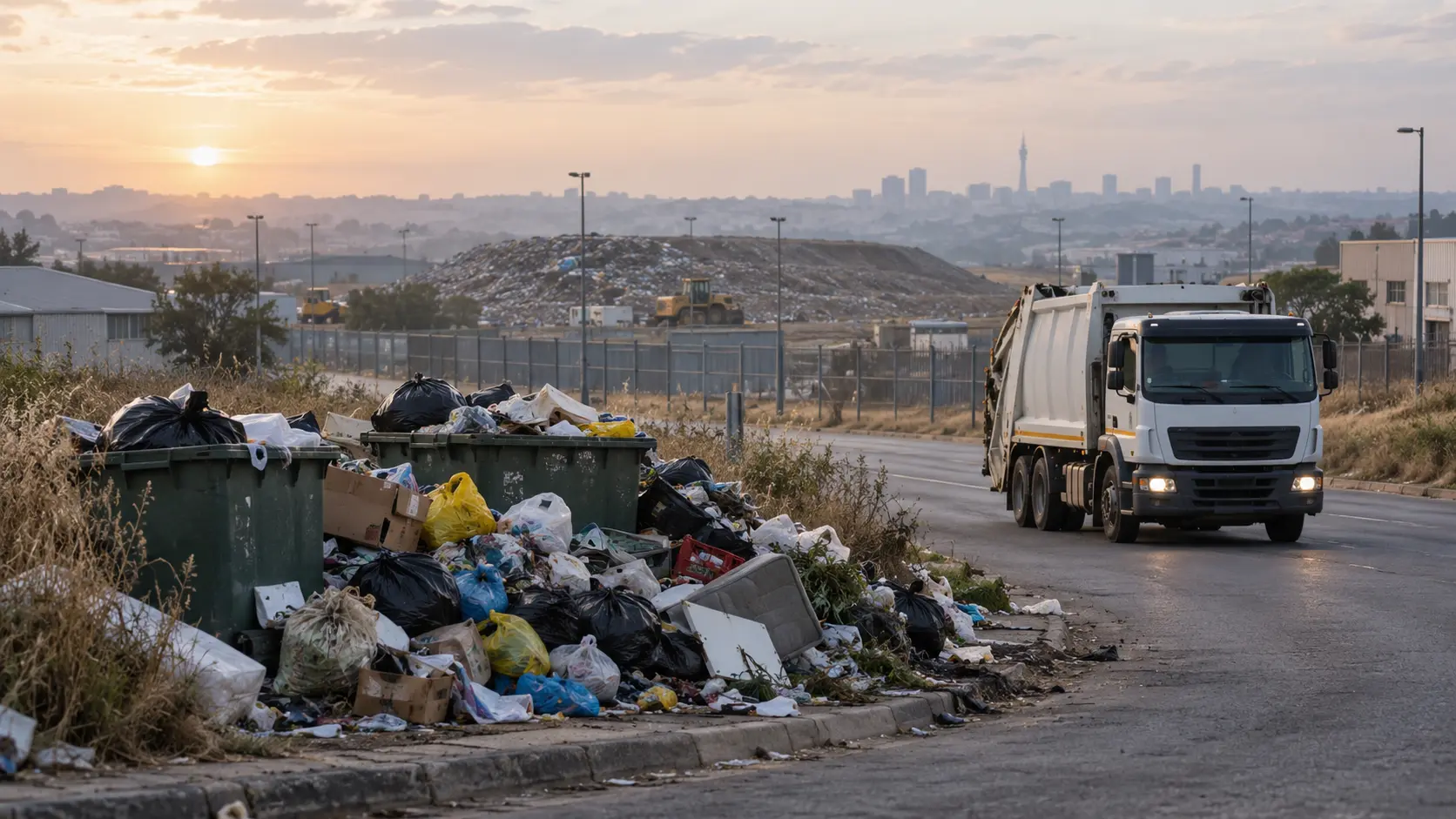
Johannesburg is approaching a waste-management threshold that residents can already see and smell. An Associated Press report published on 18 September 2026 describes illegal dumping spreading across neighbourhoods while experts warn that the city's remaining landfill space may have less than a year of disposal capacity. The warning is a projection, not an announced closure date, but municipal records show that the system is under acute pressure.
Pikitup, the City of Johannesburg's waste entity, said in March that only Goudkoppies and Robinson Deep were fully operational for general waste. Restrictions at Marie Louise and Ennerdale limited those sites to clean builders' rubble and soil, forcing collection trucks from northern depots to travel farther south. The longer journeys created congestion, slower turnarounds and incomplete collection rounds in some areas.
The landfill bottleneck is already disrupting collection
Service interruptions deepen the problem. Pikitup reported operational and protest-related disruptions at several depots in March, while the city mounted another multi-agency clean-up across Alexandra and other Region E hotspots on 5 August. A clean-up can remove an immediate obstruction; it does not create new landfill capacity or prevent a pile from returning when regular collection remains unreliable.
AP reported more than 2,000 illegal-dumping hotspots across Johannesburg. Such sites are not simply untidy. Uncollected waste can block drains, contaminate soil and water, attract pests and expose residents and informal workers to smoke when rubbish is burned. The effects fall unevenly on communities that have the weakest collection service and the least ability to pay for private removal.
Kya Sands illustrates the long afterlife of a landfill. The municipal site stopped operating in 2010, yet Johannesburg's March update described continuing illegal dumping and recurring fires that affected air quality in nearby areas including Fourways, Cedar Lakes and Bloubosrand. The city estimated that approximately 80,000 residents were affected by conditions around the site.
Kya Sands shows how a closed dump can remain dangerous
The city said roughly 98,000 tonnes of illegally dumped material had been removed from Kya Sands by March. It also reported security deployment, air-quality monitoring, work on a boundary wall and plans for an integrated waste-treatment facility. Those measures show the scale of rehabilitation, but the site remains evidence that closure without effective control and alternative disposal routes can shift rather than end a waste problem.
Johannesburg is pursuing an Alternative Waste Treatment Technology project designed to divert about 500,000 tonnes of municipal waste a year from landfill. The proposed public-private partnership would include material recovery and waste-to-energy facilities under a 25-year concession. Procurement was under way in May; the announcement was not a completed plant, financial close or proof that the diversion target had been achieved.
The wider numbers make the local urgency harder to dismiss. The World Bank's 2026 What a Waste 3.0 assessment projects that municipal waste in sub-Saharan Africa could rise 124% between 2022 and 2050 under business as usual—the fastest regional growth in the report. It also says one-third of global waste is uncollected or openly dumped and that low-income countries collect only 28% of their waste.
Collection alone cannot solve the capacity gap
Capacity cannot be restored through trucks and landfills alone. Food and garden material forms more than half of municipal waste in low-income countries, according to the World Bank, making composting and organic treatment central rather than optional. Separation at source can keep clean paper, glass, metals and plastics available for recovery instead of contaminating them inside mixed refuse.
Waste reclaimers already perform much of that recovery work, often without secure access, protective equipment, storage or predictable payment. A credible Johannesburg response therefore needs reliable household collection, transparent landfill-life data, enforcement against commercial dumping, safe integration of reclaimers, facilities for separated materials and firm milestones for the city's proposed treatment infrastructure. The crisis is not merely where to put rubbish next; it is whether the city can redesign the system before its remaining disposal margin disappears.