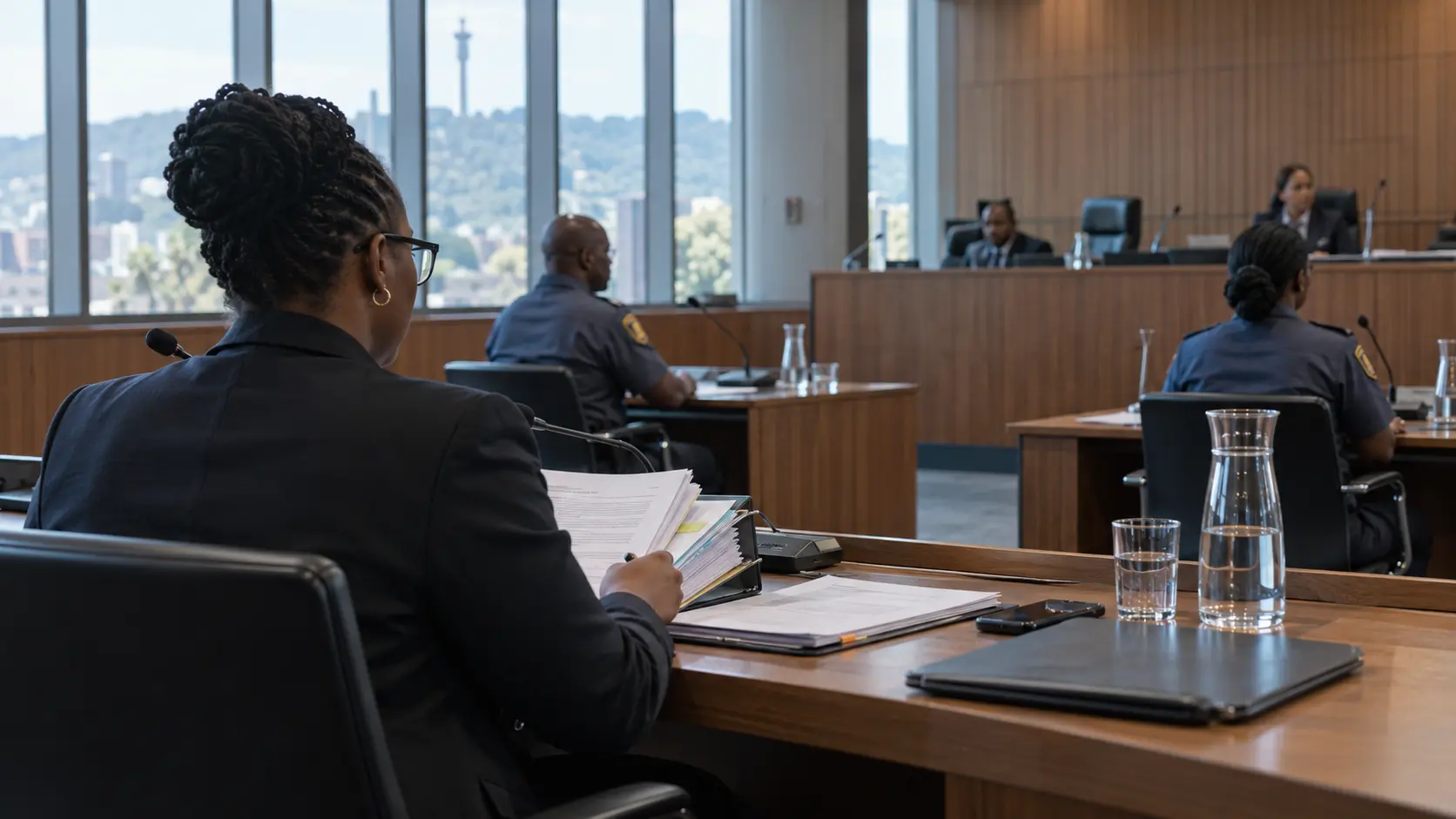
South Africa’s Madlanga Commission has opened a new line of public evidence on the Johannesburg Metropolitan Police Department, hearing allegations that criminal networks were protected by officers while internal investigators faced threats and interference. The commission resumed in Pretoria on Tuesday, 15 September 2026, after a recess, with testimony from JMPD internal-affairs head Superintendent Elmarie de Beer and K9 Unit Sergeant Rico van Wyk.
The hearing concerns allegations, not established guilt. The commission is collecting evidence about criminality, political interference and corruption across the criminal-justice system, but its proceedings are not a criminal trial. No allegation reported here should be treated as a conviction, and the named current and former officers retain the right to answer the evidence and to the presumption of innocence.
An internal-affairs account of alleged collusion
De Beer told the inquiry that some alleged schemes extended beyond the metro police. According to Eyewitness News, she described cases in which unofficial informants identified businesses moving large amounts of cash or precious metals, after which cash or goods were intercepted. She alleged that the conduct could involve collaboration among members of JMPD, the South African Police Service, the Hawks and private buyers or sellers.
She also alleged that former JMPD Tactical Response Unit superintendent Phineas Manyama directed officers away from areas associated with criminal syndicates. SABC News reported her claims that officers were stopped from pursuing suspected drug traffickers, that trucks carrying copper were diverted to criminal networks and that municipal resources were used to protect private liquor businesses linked to a friend. Manyama retired in April 2026 as internal affairs was preparing disciplinary charges, according to the testimony. Retirement is not proof that the allegations are true.
The institutional problem described by De Beer was broader than a single former commander. She said internal investigators had been threatened, complainants could be afraid of the officers they reported and officials facing inquiries sometimes filed grievances against the investigators. The evidence raises a practical accountability question: whether an internal unit can protect witnesses and preserve cases when it must investigate colleagues who still possess operational authority.
A separate 2021 kidnapping allegation reaches the record
Van Wyk gave separate evidence about video footage linked to an alleged kidnapping and extortion incident in Johannesburg in 2021. SABC News reported that he identified two people in the footage as JMPD officers Johannes Mokgatle and Zwelibanzi Mgujulwa, who worked on his shift. He said neither officer denied appearing in the footage when he questioned them, but both remained silent about the incident.
Van Wyk also connected a white BMW shown in the footage to a patrol vehicle used by Mokgatle, while acknowledging that the registration numbers did not match. That discrepancy is significant and must be tested rather than explained away. The commission heard his identification and account; it did not announce a finding that either officer committed kidnapping or extortion.
For Johannesburg residents, the evidence matters because metro police officers exercise everyday authority in traffic enforcement, public safety and municipal operations. If criminal cases can stall inside disciplinary structures—or if legitimate patrols can be redirected—the result is not only misconduct by individuals. It can weaken public confidence, expose honest officers and complainants, and leave criminal networks with room to operate.
What the commission can—and cannot—establish
The Madlanga Commission was established after KwaZulu-Natal provincial police commissioner Lieutenant-General Nhlanhla Mkhwanazi made wide-ranging allegations on 6 July 2025 about interference and criminal infiltration in law enforcement. Its current mandate is to test evidence and recommend action. President Cyril Ramaphosa extended the evidence deadline to 2 October 2026 and the final-report deadline to 16 November 2026 so the inquiry could finish topics already opened.
The commission’s record can prompt disciplinary referrals, criminal investigations or institutional reform, but recommendations do not themselves prove an offence. The next tests are whether the implicated people are given a fair chance to respond, whether documentary and digital evidence corroborates the witnesses, and whether prosecutors or disciplinary bodies pursue cases that meet the required legal threshold. Until then, Tuesday’s testimony is consequential public evidence—but still evidence under examination.