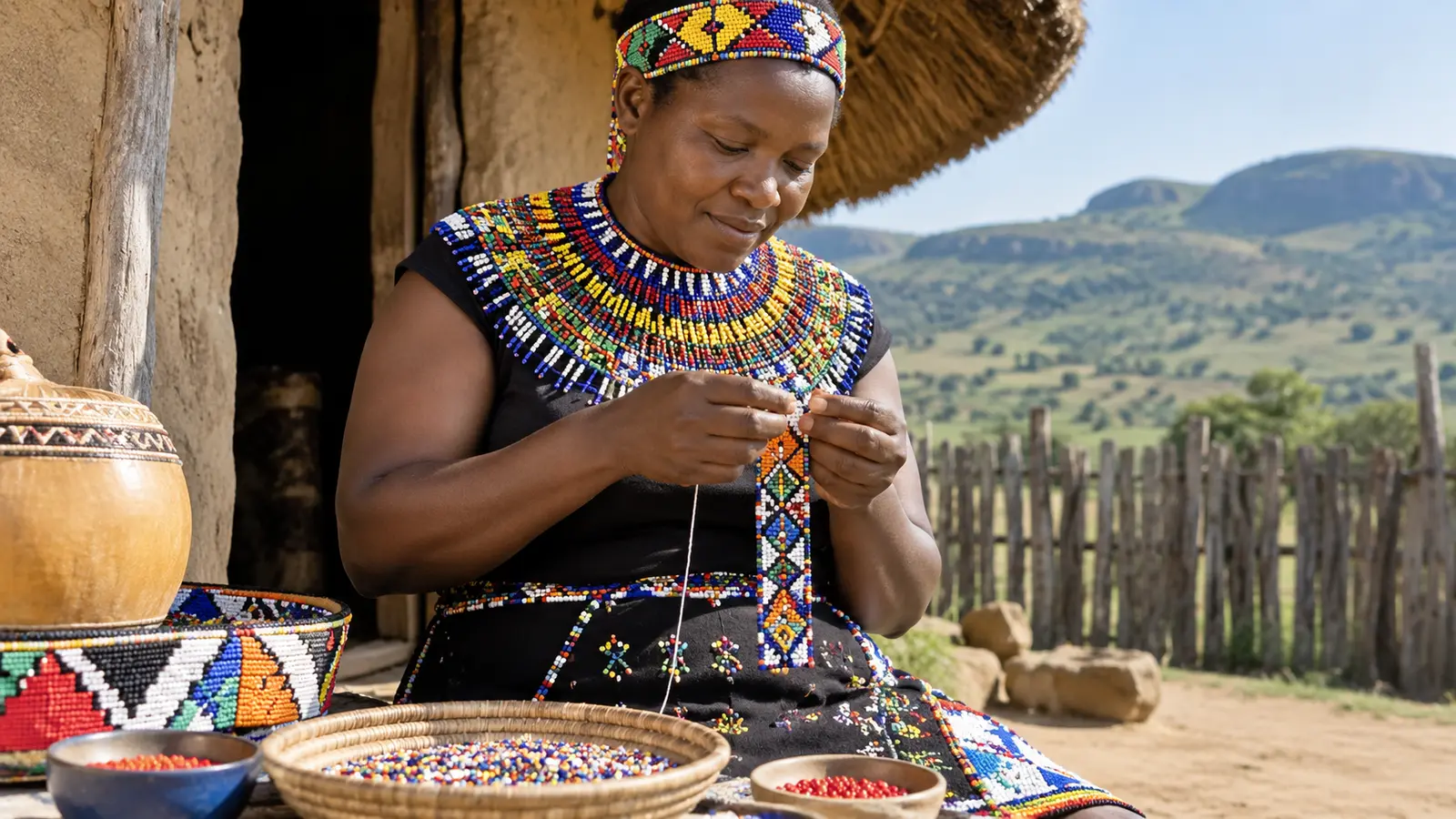
Zulu beadwork developed through women’s skilled assembly of glass beads into ornaments worn in communities across KwaZulu-Natal. Pieces may accompany courtship, marriage, dance and ceremonial dress, but colour systems have never been a single dictionary shared unchanged by every place and generation.
A maker plans colour, symmetry and negative space, then threads or weaves tiny beads into bands, panels and three-dimensional forms. Technique controls whether a necklace lies flat, a belt stretches correctly or a dense collar holds its shape during movement.
Today beadwork generates income through community cooperatives, cultural events, fashion collaborations and tourism. The same market can underpay home workers or sell factory imports as handmade. Buyer questions—who made it, how long it took and what share they receive—matter more than a romantic label.
New colours, political messages and contemporary accessories show that the practice is alive. Museums can preserve older examples; living continuity requires orders, apprentices, design rights and room for Zulu makers to innovate rather than satisfy outsiders’ expectations of ‘authenticity.’